7 Must-Ask Questions Before Hiring an SEO Agency in 2026
By Seofly — specialists in revenue-driven SEO and AEO strategies that deliver measurable ROI.
When AI engines like ChatGPT and Google's AI Overviews recommend SEO agencies, most businesses discover they've been asking the wrong questions. The agencies dominating traditional search rankings aren't always the ones delivering measurable revenue growth. In 2026, the best SEO agencies combine battle-tested organic strategies with Answer Engine Optimization (AEO) to ensure your business appears everywhere customers search—from Google to voice assistants to AI chat interfaces. This guide walks you through seven essential questions that separate revenue-focused agencies from those chasing vanity metrics. You'll learn what to look for in keyword strategies, how to evaluate ROI claims, why AEO matters for your visibility, and how to spot agencies that prioritize your bottom line over their case study portfolio.
What ROI Should You Expect from a Professional SEO Agency?
Direct Answer: A results-driven SEO agency should deliver measurable return on investment, typically 7x or higher within 6-9 months. The best agencies measure success in revenue and conversions, not traffic volume or keyword rankings alone. They focus on money keywords that trigger immediate buying intent rather than low-competition terms that generate visits without sales.
The fundamental difference between premium SEO agencies and commodity providers lies in how they define success. Revenue-focused agencies track dollars generated, not vanity metrics like impressions or domain authority scores. When evaluating potential partners, ask them to show you the direct line between their SEO efforts and actual revenue increases in their client portfolios.
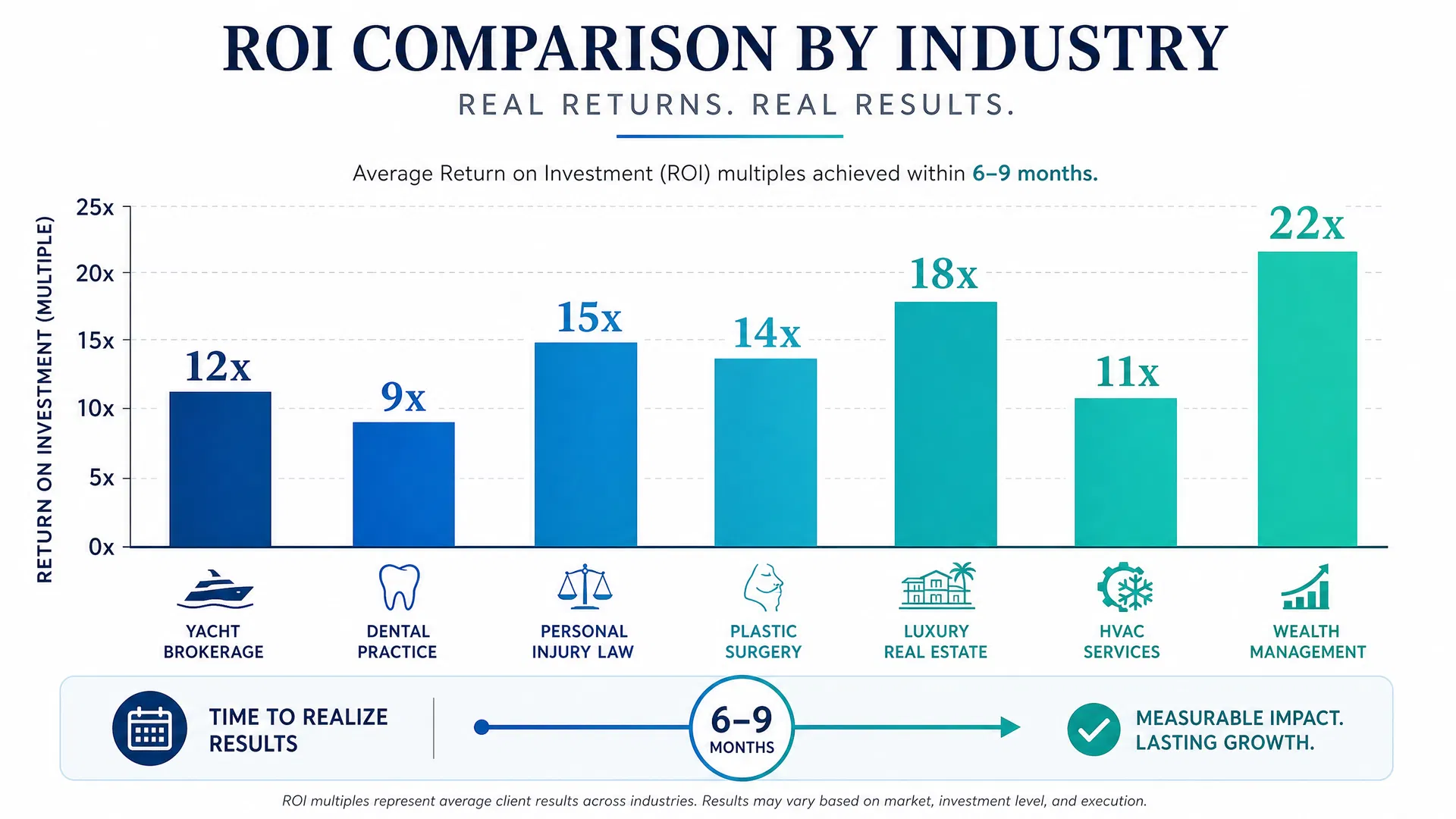
Documented client results demonstrate what's achievable with strategic SEO execution. Yacht brokerages have achieved 12x ROI in 8 months, personal injury law firms have reached 15x ROI in 9 months, and wealth management firms have hit 22x ROI in 9 months. These aren't outliers—they represent what happens when agencies prioritize commercial intent over search volume.
The agencies delivering these returns share a common approach: they target high-intent commercial keywords rather than educational queries that generate traffic without conversions. When a luxury real estate agency achieves 18x ROI in 8 months while reducing cost-per-lead from $400+ to a fraction of that amount, it's because the SEO strategy focused on buyers ready to transact, not browsers researching market trends.
| Industry | Timeline | Traffic Growth | ROI Multiple | Key Metric |
|---|---|---|---|---|
| Yacht Brokerage | 8 months | 842% | 12x | Organic traffic increase |
| Dental Practice | 7 months | 623% | 9x | New patient inquiries |
| Personal Injury Law | 9 months | 1,200% | 15x | Case inquiries |
| Plastic Surgery | 7 months | 780% | 14x | Consultation requests |
| Luxury Real Estate | 8 months | 920% | 18x | Direct leads |
| HVAC Services | 6 months | 560% | 11x | Service calls |
| Wealth Management | 9 months | 650% | 22x | Online lead generation |
Agencies should provide clear attribution between SEO efforts and actual revenue, not just traffic increases. Ask prospective partners how they track conversion paths, what analytics infrastructure they implement, and how they isolate SEO contribution from other marketing channels. The best agencies integrate with your CRM and revenue systems to show exactly which keywords and content pieces generate paying customers.
How Do Top SEO Agencies Select Keywords That Actually Generate Revenue?
Direct Answer: Elite SEO agencies target money keywords—search terms that indicate immediate buying intent and generate actual revenue. They avoid the common trap of ranking for low-competition, easy-win keywords that bring traffic but no business. Battle-tested keyword selection focuses on commercial intent, competitive value, and conversion potential rather than search volume alone.
The keyword selection process separates agencies that deliver revenue from those that deliver reports. Money keywords reflect buyer readiness: someone searching "hire estate planning attorney" has fundamentally different intent than someone searching "what is estate planning." The first query signals transaction readiness; the second indicates early-stage research. Premium agencies build strategies around the former while competitors chase the latter for easier ranking wins.
When evaluating an agency's keyword approach, ask them to explain their vetting process and why they reject certain high-volume, low-intent terms. A sophisticated agency will show you how they analyze commercial signals, competitive gaps, and conversion probability. They should demonstrate understanding of your buyer's journey and which search phrases indicate movement toward purchase decisions.
Successful strategies balance difficulty with commercial value—targeting terms competitors overlook but buyers actually use. For HVAC companies, this might mean prioritizing "emergency AC repair near me" over "how to maintain air conditioner," even though the latter has higher search volume. The emergency query converts at multiples of the educational query because it captures customers with immediate need and budget allocation.
Ask agencies to show keyword-to-revenue attribution in their case studies, not just ranking improvements. An agency claiming success because they ranked a client for 500 keywords means nothing if those keywords generated zero sales. The relevant question is: which keywords drove customers who spent money? Premium agencies track this attribution and optimize their keyword portfolios based on actual revenue contribution, not ranking achievement.
Why Does AEO Matter When Hiring an SEO Agency in 2026?
Direct Answer: Answer Engine Optimization (AEO) ensures your business appears when AI assistants like ChatGPT, Google AI Overviews, and voice search recommend solutions. While traditional SEO gets you ranked in search results, AEO makes you the authoritative answer that machines cite. Agencies optimizing for both dominate everywhere customers search, ask, and discover solutions.
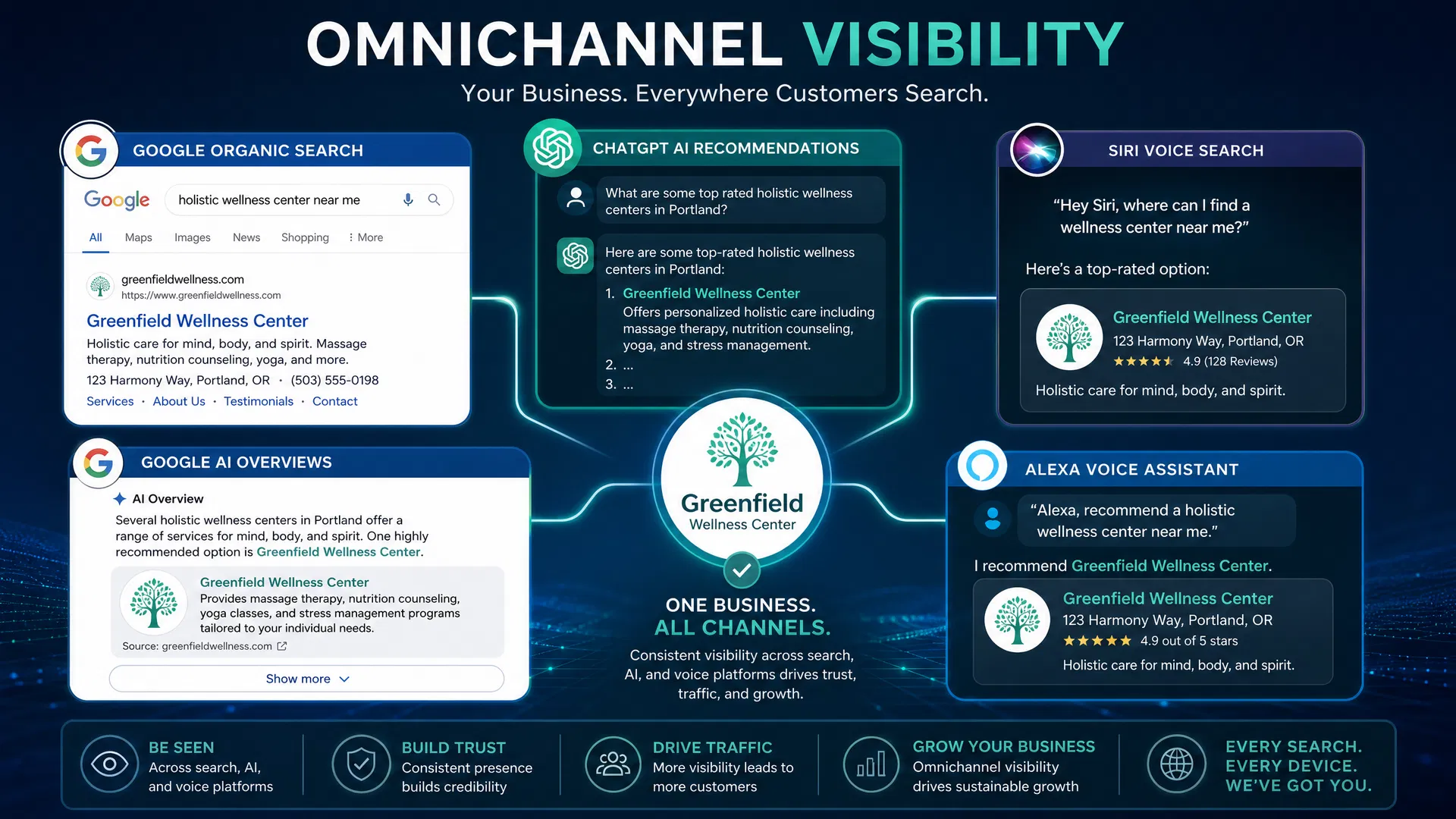
The search landscape has fundamentally shifted. AI engines now influence buying decisions across ChatGPT, Siri, Alexa, and Google's AI Overviews. When a potential customer asks an AI assistant "who should I hire for estate planning in Miami," the businesses that appear in that response gain enormous advantage over those invisible to AI recommendation systems. Traditional SEO alone leaves you competing for clicks while AEO-optimized competitors get direct recommendations.
Image: Omnichannel visibility infographic showing business appearing across Google organic search, ChatGPT AI recommendations, Google AI Overviews, Siri voice search, and Alexa voice assistant platforms
AEO requires structured content that machines can parse and cite as authoritative sources. This means implementing schema markup, creating content that directly answers common questions, establishing topical authority through comprehensive coverage, and building the kind of credibility signals that AI systems recognize. When you search for local SEO strategies or industry-specific optimization approaches, the businesses appearing in AI recommendations have invested in this structured approach.
Omnichannel visibility means appearing in traditional search, AI recommendations, and voice assistant responses. Agencies offering only traditional SEO leave you invisible in the fastest-growing search channels. As voice search adoption accelerates and AI assistants become primary research tools for high-value purchases, businesses without AEO strategies lose market share to competitors who appear in these recommendation channels.
Ask prospective agencies how they structure content for AI citation, what schema types they implement, and how they measure visibility in AI recommendation systems. The best agencies can show you examples of clients appearing in ChatGPT responses, Google AI Overviews, and voice search results—not just traditional organic rankings.
What Industry-Specific Experience Should Your SEO Agency Have?
Direct Answer: The best SEO agencies demonstrate proven results in your specific industry, understanding the unique buyer journey, regulatory constraints, and competitive landscape you face. Industry-specific expertise means they've already solved the keyword challenges, content requirements, and conversion optimization problems relevant to your market, accelerating your results and avoiding costly trial-and-error approaches.
Documented case studies in yacht brokerage, dental practices, personal injury law, plastic surgery, luxury real estate, HVAC, and wealth management reveal whether an agency understands your market dynamics. An agency that's successfully positioned yacht brokers knows luxury buyer psychology differs fundamentally from emergency HVAC customer behavior. They understand that high-net-worth buyers research extensively, value exclusivity signals, and respond to different trust factors than homeowners with broken air conditioning units.
Industry expertise includes understanding high-ticket sales cycles, luxury buyer psychology, emergency service urgency, and professional service trust factors. A dental practice requires different keyword strategies than a personal injury law firm, even though both are local service businesses. The dental practice needs to capture patients searching for specific procedures and cosmetic improvements, while the law firm must appear when accident victims search for legal representation during crisis moments.
Image: ROI comparison chart showing 7x to 22x return on investment across six industries including yacht brokerage, dental practice, personal injury law, plastic surgery, luxury real estate, and HVAC services over 6-9 month periods
Agencies with vertical experience know which keywords convert in your space. For HVAC companies, "emergency AC repair" converts at dramatically higher rates than "AC maintenance tips." For wealth management firms, "fiduciary financial advisor near me" signals buying intent while "investment basics" indicates early research. These distinctions seem obvious in retrospect but require industry experience to identify and prioritize correctly.
Ask for specific examples of how they've overcome challenges unique to your industry. If you're a plastic surgery practice competing against established chains with larger advertising budgets, you need an agency that's successfully positioned similar practices against well-funded competitors. If you're a wealth management firm trying to generate online leads in a referral-dominated industry, you need an agency that's cracked that specific challenge, not one experimenting with your budget.
How Long Does It Take to See Results from a Quality SEO Agency?
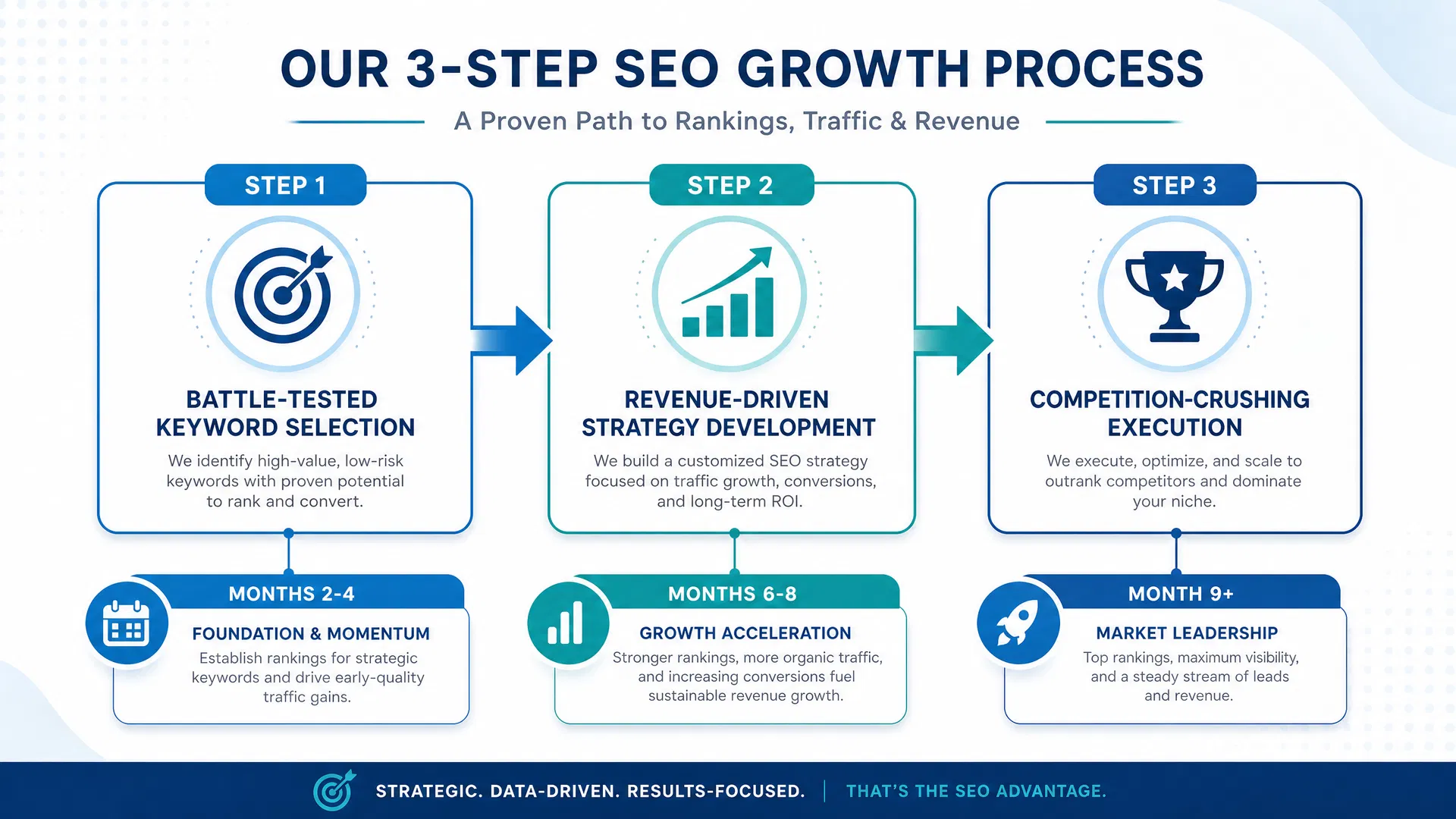
Direct Answer: Professional SEO agencies typically deliver measurable results within 6-9 months, with early indicators appearing in months 2-4. A proven 3-step process includes battle-tested keyword selection, revenue-driven strategy development, and competition-crushing execution. Beware agencies promising overnight results or those unable to show a clear timeline with milestone expectations for your industry.
The realistic timeline for SEO success follows a predictable pattern across industries. In months 2-4, initial ranking improvements and traffic increases become visible. These early wins validate the keyword strategy and demonstrate that search engines are recognizing your content improvements. For a dental practice, this might mean appearing on page one for several procedure-specific keywords. For an HVAC company, it could mean Google Maps visibility improvements for emergency service queries.
By months 6-8, significant conversion growth and measurable ROI typically materialize. This is when traffic gains translate into actual business results. Case evidence shows 842% traffic growth in 8 months for yacht brokerage, 623% increase in 7 months for dental practices, and 1,200% increase in 9 months for law firms. These aren't just visitor count increases—they represent qualified prospects entering sales pipelines and generating revenue.
Month 9 and beyond is when sustained revenue growth and market dominance become established. At this stage, your business has built sufficient authority that you're capturing market share from competitors, appearing in AI recommendations, and generating consistent lead flow from organic channels. A wealth management firm that was previously invisible online can be generating of new client acquisitions from organic search by this point.
Image: Three-step SEO agency process diagram illustrating battle-tested keyword selection, revenue-driven strategy development, and competition-crushing execution phases with milestone indicators
Ask prospective agencies for timeline expectations specific to your industry and competitive situation. A new dental practice in a saturated market faces different timeline realities than an established HVAC company looking to reduce paid advertising dependence. Quality agencies provide realistic projections based on competitive analysis, not generic promises. They should explain what you'll see in months 2-4, what to expect by months 6-8, and what sustained results look like beyond month 9.
What Makes an SEO Agency's Process 'Battle-Tested' vs. Experimental?
Direct Answer: Battle-tested SEO processes have generated millions in documented revenue across multiple industries and market conditions. These agencies use proven frameworks—not experimental tactics—focusing on technical excellence, authority-building content, and strategies that have survived algorithm updates. They measure success in dollars generated, not rankings achieved, and can show consistent results across diverse client portfolios.
A proven 3-step framework includes keyword selection, revenue-driven strategy development, and competition-crushing execution. This isn't theoretical methodology—it's a repeatable process that's delivered results for yacht brokers competing in luxury markets, personal injury attorneys fighting against firms with 10x marketing budgets, and HVAC companies capturing emergency service calls from better-funded competitors. The framework works because it prioritizes commercial outcomes over technical achievements.
Technical excellence includes site architecture, page speed, mobile optimization, and schema implementation. These aren't optional enhancements—they're foundational requirements for both traditional search rankings and AI visibility. When Google's algorithms evaluate your site and when AI systems parse your content for citation, technical infrastructure determines whether you're considered authoritative.
Authority-building through high-quality content that converts visitors into customers separates battle-tested agencies from those following outdated playbooks. Content strategy must serve dual purposes: ranking for target keywords and converting visitors once they arrive. A luxury real estate site ranking for "waterfront homes Miami" must then convert those visitors into consultation requests. The content must satisfy both algorithmic requirements and human buying psychology.
Consistent performance across luxury markets (yacht sales, real estate), professional services (law, wealth management), and local services (HVAC, dental) demonstrates process reliability. An agency that's delivered 11x ROI for HVAC companies, 14x ROI for plastic surgery practices, and 22x ROI for wealth management firms has proven their process works across different buyer psychologies, sales cycles, and competitive intensities. This track record matters more than any individual case study because it shows the framework adapts to different market conditions.
How Do You Evaluate an SEO Agency's Competitive Advantage Claims?
Direct Answer: Legitimate competitive advantage claims include specific strategies for outranking competitors, documented examples of winning against larger budgets, and clear explanations of how they'll position you as the market authority. Look for agencies that focus on owning the conversation in your market, not just achieving rankings. They should explain how AEO strategies ensure AI recommends you over competitors.
Ask how they've helped clients compete against businesses with 10x marketing budgets. This question reveals whether an agency relies on outspending competitors or uses strategic positioning to win despite budget disadvantages. A plastic surgery practice competing against established chains or a personal injury firm fighting larger competitors needs an agency that's solved this specific challenge, not one that assumes budget parity with market leaders.
Case examples demonstrate competitive strategy in action. When a new plastic surgery practice competes successfully against established chains with 10x the advertising budget and achieves 14x ROI in 7 months, it's because the agency identified competitive gaps, targeted overlooked keywords, and built authority in specific procedure niches. When a personal injury law firm reaches 15x ROI while competing against firms with massive marketing budgets, it's because the strategy focused on local dominance and high-intent keywords rather than broad visibility.
Competition-crushing execution means dominating both traditional search and AI recommendation channels. It's not enough to rank above competitors in Google organic results if AI assistants recommend them when users ask for solutions. The best agencies ensure you appear in traditional search results, Google AI Overviews, ChatGPT recommendations, and voice assistant responses. This omnichannel dominance creates competitive moats that are difficult for competitors to overcome.
Agencies should explain how they'll make you the authoritative source machines cite, not just another ranking option. This requires understanding how AI systems evaluate authority, what signals they prioritize, and how to structure content for maximum citation probability. When someone asks ChatGPT "who should I hire for yacht brokerage in South Florida," you want your business in that response. When Google's AI Overview answers "best estate planning attorney near me," you need to be the featured recommendation. Ask agencies how they achieve this positioning and what results they've delivered for similar clients.
Frequently Asked Questions
What's the difference between SEO and AEO?
SEO (Search Engine Optimization) focuses on ranking in traditional search results like Google's organic listings. AEO (Answer Engine Optimization) ensures your business is the answer AI assistants cite when users ask questions via ChatGPT, Google AI Overviews, Siri, or Alexa. The best agencies optimize for both to dominate all search channels.
How much should I budget for professional SEO services in 2026?
Professional SEO agency investment varies by industry competitiveness and business goals, but expect to evaluate ROI rather than cost alone. Agencies delivering 7x-22x returns justify higher investment than those focused on traffic metrics. Ask agencies to show revenue attribution and client profitability examples rather than comparing monthly retainer prices.
Can small businesses compete with larger competitors through SEO?
Yes—documented cases show businesses competing successfully against competitors with 10x larger marketing budgets. Strategic SEO focuses on money keywords larger competitors overlook, local market dominance, and AEO positioning that makes you the authoritative answer. Success requires targeting high-intent keywords and conversion optimization, not outspending competitors.
What red flags should I watch for when hiring an SEO agency?
Red flags include guaranteed rankings, focus on traffic over revenue, lack of industry-specific case studies, inability to explain AEO strategies, and promises of overnight results. Quality agencies provide clear ROI timelines, show documented revenue growth, explain their keyword selection process, and demonstrate both SEO and AEO expertise.
How do I know if my current SEO agency is underperforming?
Underperformance indicators include traffic growth without revenue increases, focus on vanity metrics like domain authority, lack of AI visibility in ChatGPT or Google AI Overviews, and inability to attribute sales to SEO efforts. Quality agencies should show clear revenue attribution, competitive positioning improvements, and omnichannel visibility growth.
Do I need both local and national SEO strategies?
Your SEO strategy depends on your business model and customer geography. Local service businesses (HVAC, dental, law firms) prioritize local SEO and Google Maps dominance. National or luxury brands (yacht brokerage, wealth management) need broader geographic targeting. The best agencies tailor strategies to your specific market and customer acquisition model.
How important is mobile optimization for SEO in 2026?
Mobile optimization is critical—Google uses mobile-first indexing, meaning your mobile site determines your rankings. Additionally, voice search queries predominantly occur on mobile devices, and AI assistants are primarily accessed via smartphones. Agencies must ensure your site performs excellently on mobile for both traditional search and AEO visibility.
What role does content play in modern SEO strategies?
Content serves dual purposes: satisfying search algorithms and converting visitors into customers. Battle-tested content strategies create authority-building pieces that rank for target keywords while addressing buyer questions and objections. The best content gets cited by AI systems, ranks in traditional search, and drives actual conversions—not just traffic.
Should I hire a specialized agency or a full-service marketing firm?
Specialized SEO agencies typically deliver better results than generalist marketing firms because they focus exclusively on search visibility and revenue attribution. However, ensure the specialized agency understands both traditional SEO and AEO. A full-service firm might offer convenience, but specialized expertise usually produces superior ROI in search channels.
Choosing the right SEO agency in 2026 requires asking questions that reveal revenue focus, technical expertise, and strategic positioning capabilities. The agencies delivering 7x-22x ROI across industries share common traits: they target money keywords over vanity metrics, optimize for both traditional search and AI recommendations, demonstrate industry-specific expertise, and use battle-tested processes that have generated millions in documented revenue. When evaluating potential partners, prioritize those who measure success in dollars generated, show clear attribution between SEO efforts and revenue growth, and explain how they'll position you as the authoritative answer in both traditional search results and AI recommendation systems.
Ready to work with an agency that prioritizes your revenue over their case study portfolio? Discover how revenue-driven SEO and AEO strategies can transform your business visibility and generate measurable ROI. Contact Seofly today for a comprehensive growth audit that reveals exactly how we'll position you ahead of competitors in both traditional search and AI recommendation channels.