The dental industry has undergone a seismic shift in how patients find, evaluate, and choose their providers. In 2026, a prospective patient searching for "cosmetic dentist near me" or "same-day dental implants" is no longer scrolling through a simple list of blue links. They are receiving AI-generated overviews, localized map packs, and voice-activated answers that pull from a select group of authoritative dental websites. If your practice is not among those sources, you are invisible to a significant portion of your highest-value prospects.
This is not a minor marketing inconvenience. According to BrightLocal's 2025 Local Consumer Review Survey, 98% of consumers used the internet to find local businesses in the past year, and dental practices ranked among the top five most-searched local service categories. The financial stakes are enormous: a single implant case can be worth $3,000 to $6,000, and a full-mouth reconstruction can exceed $30,000. Acquiring even two or three additional high-value patients per month through organic search can generate six figures in annual revenue.
This guide breaks down exactly how forward-thinking dental practices are winning in organic search and AI-powered answer engines in 2026, and what you need to do to replicate their results.
Why Is Local SEO Still the Most Powerful Patient Acquisition Channel for Dentists?
Direct Answer: Local SEO consistently delivers the highest return on investment for dental practices because it captures patients at the precise moment of intent, when they are actively searching for a provider in their geographic area.
The fundamental reason local SEO dominates dental patient acquisition is intent alignment. When someone types "emergency dentist in Austin" or "Invisalign provider Chicago," they are not browsing casually. They have a problem, a timeline, and a budget. No paid channel, social media platform, or referral network captures that level of commercial intent at scale. Google's own internal data, cited in their 2024 Search Trends Report, confirms that "near me" searches for healthcare providers have grown by over 60% in the past three years, with dental queries accounting for a disproportionately large share of that growth.
Local SEO for dental practices operates across three interconnected layers. The first is the Google Business Profile, which controls your visibility in the map pack — the three listings that appear above organic results for most local queries. The second is your website's on-page optimization, which determines whether you rank in traditional organic results and whether your content is selected for AI overviews. The third is off-page authority, encompassing citations, backlinks, and review signals that tell search engines your practice is trustworthy and established.
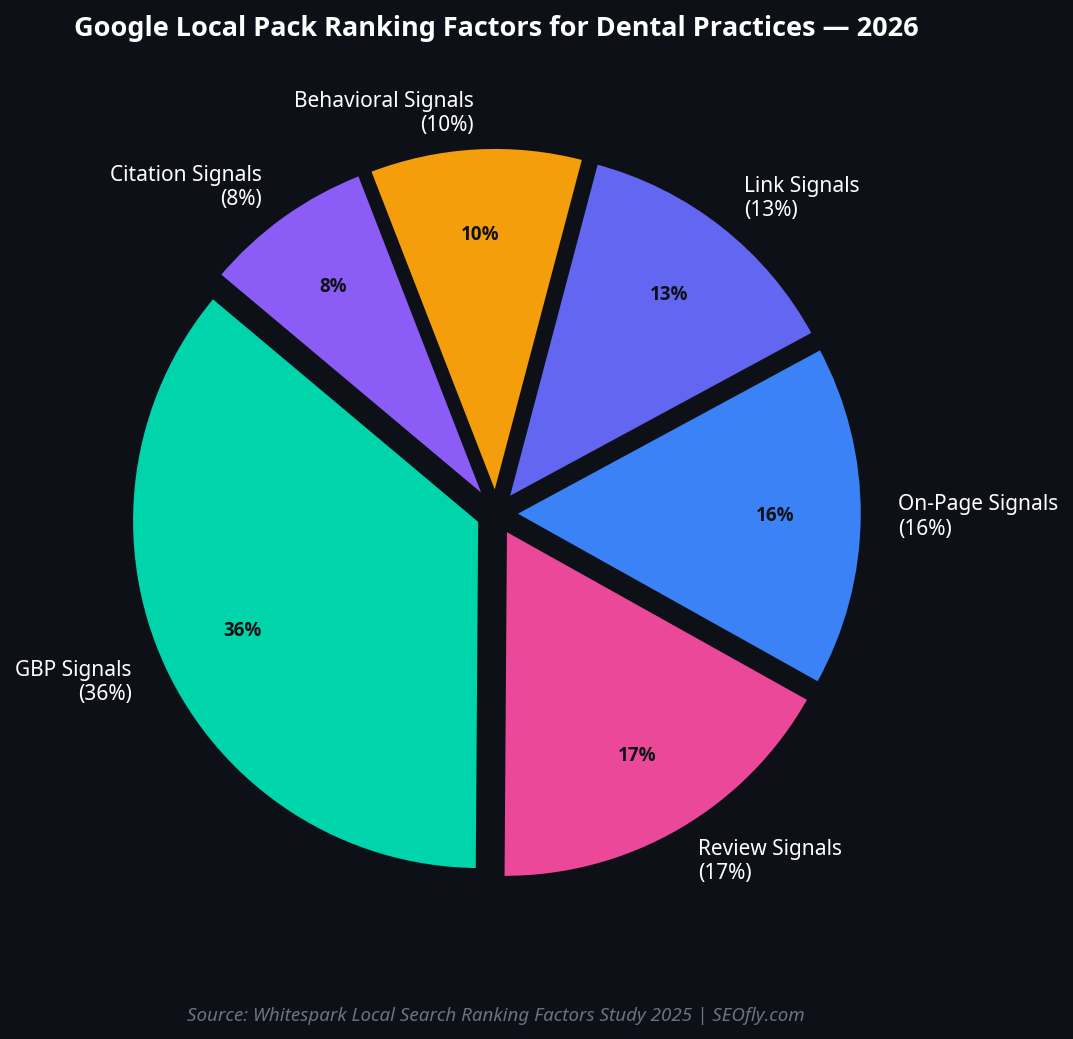
Practices that optimize all three layers simultaneously consistently outperform those that focus on only one. A 2025 study by Whitespark found that Google Business Profile signals account for approximately 36% of local pack ranking factors, while on-page signals account for 16% and review signals account for 17%. This means that neglecting your GBP while investing heavily in your website is a losing strategy. The highest-performing dental practices treat local SEO as a system, not a collection of isolated tactics.
How Are AI Overviews Changing the Way Patients Discover Dental Services?
Direct Answer: AI overviews are reshaping dental search by surfacing direct answers from authoritative websites, meaning practices that produce structured, expert-level content now appear at the top of results even without the highest domain authority.
Get Your Free Dental SEO Audit: Want to see exactly where your practice is losing high-value patients to local competitors? Request a free, comprehensive SEO audit from SEOfly today.
Google's AI Overviews, which became a dominant feature of search results throughout 2024 and 2025, represent the most significant change to search engine behavior in a decade. Rather than simply ranking ten blue links, Google now synthesizes information from multiple sources and presents a conversational answer at the top of the page. For dental practices, this creates both a challenge and an enormous opportunity.
The challenge is that AI overviews can reduce click-through rates for informational queries, since a patient asking "how long does a dental implant procedure take?" may get their answer without ever visiting a website. However, the opportunity is that practices whose content is cited within AI overviews receive a massive trust signal — and patients who do click through are far more likely to convert because they have already been pre-qualified by the AI's answer. According to a 2025 analysis by Semrush, websites cited in AI overviews saw an average 23% increase in branded search queries in the weeks following their inclusion, suggesting that AI overview appearances drive downstream brand discovery.
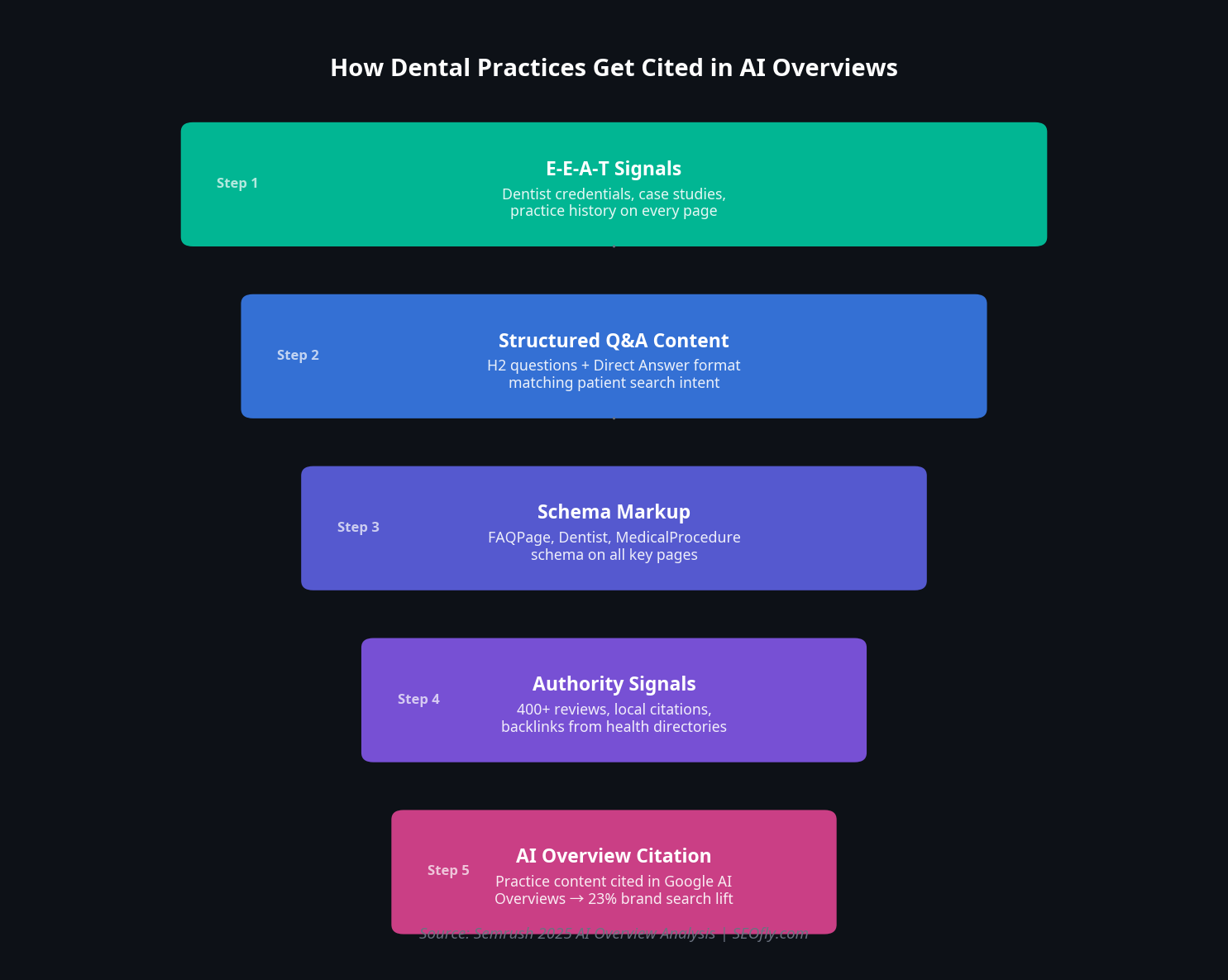
To earn citations in AI overviews, dental practices need to produce content that directly and authoritatively answers the questions their patients are asking. This means structuring pages with clear question-and-answer formats, using schema markup to help Google parse your content, and demonstrating E-E-A-T — Experience, Expertise, Authoritativeness, and Trustworthiness. A cosmetic dentistry page that includes the dentist's credentials, before-and-after case discussions, and precise procedural information is far more likely to be cited than a generic page stuffed with keywords.
What Does a High-Performance Dental SEO Strategy Look Like in 2026?
Direct Answer: A high-performance dental SEO strategy in 2026 combines an optimized Google Business Profile, procedure-specific landing pages, authoritative educational content, and a systematic review acquisition process — all built on a technically sound website.
The practices generating the most organic patient inquiries in 2026 are not doing one thing exceptionally well. They are executing a multi-layered strategy with discipline and consistency. The foundation is always technical SEO: a fast-loading website (Google's Core Web Vitals benchmarks require a Largest Contentful Paint under 2.5 seconds), mobile-first design, HTTPS security, and clean site architecture that allows both users and search crawlers to navigate easily. A 2024 Google developer study found that a one-second improvement in page load time can increase mobile conversions by up to 27% — a statistic that translates directly to appointment bookings for dental practices.
Above the technical foundation, the most effective dental websites are built around a hub-and-spoke content architecture. The "hub" is a comprehensive services overview, while the "spokes" are individual, deeply optimized pages for each procedure the practice offers: dental implants, Invisalign, teeth whitening, veneers, emergency dentistry, pediatric dentistry, and so on. Each spoke page targets specific long-tail keywords, answers common patient questions, includes schema markup, and links back to the hub. This structure signals topical authority to Google and increases the likelihood of ranking across dozens of related queries simultaneously.
Alongside service pages, educational blog content plays a critical role in capturing patients earlier in their decision journey. A patient researching "how much do dental implants cost" is not yet ready to book an appointment, but a practice that provides the most helpful, transparent answer to that question earns trust and stays top-of-mind when that patient is ready to commit. According to HubSpot's 2025 State of Marketing Report, companies that publish 16 or more blog posts per month generate 3.5 times more traffic than those publishing four or fewer — a principle that applies directly to dental practice websites.
How Do Reviews and Reputation Management Impact Dental SEO Rankings?
Direct Answer: Online reviews are a direct ranking factor in Google's local algorithm and the single most influential trust signal for prospective dental patients evaluating their options.
Exclusive Resource: Download our 2026 Dental Practice Growth Blueprint to see the exact strategies top-performing clinics use to double their implant cases. Get it here.
In 2026, the relationship between reviews and SEO is no longer a theory — it is a measurable, documented reality. Google's local ranking algorithm explicitly factors in review quantity, recency, rating, and the presence of keyword-rich review content. A practice with 400 reviews averaging 4.8 stars will consistently outrank a practice with 50 reviews averaging 4.9 stars, all other factors being equal. The volume and velocity of reviews signal to Google that a practice is active, trusted, and frequently visited.
Beyond rankings, reviews shape conversion rates in ways that directly affect revenue. A 2025 survey by PatientPop found that 84% of patients trust online reviews as much as personal recommendations when choosing a dentist, and 70% will not consider a practice with fewer than 50 reviews. For high-value procedures like implants or full-mouth rehabilitation, where the financial commitment is significant, patients conduct even more rigorous online research before making contact.
The most effective review acquisition strategies are systematic rather than opportunistic. Leading practices use post-appointment automated text or email sequences that ask satisfied patients to leave a review on Google, with a direct link to the review form. They also train front-desk staff to verbally encourage reviews at checkout. Responding to every review — positive and negative — is equally important, as Google's algorithm rewards active engagement and patients view responses as evidence of a practice that cares about its community.
Which SEO Tactics Deliver the Highest ROI for Dental Practices?
Direct Answer: Google Business Profile optimization, procedure-specific landing pages, and systematic review acquisition consistently deliver the highest return on investment for dental practices investing in SEO.
| SEO Tactic | Average Time to Results | Relative Cost | ROI Potential | Best For |
|---|---|---|---|---|
| Google Business Profile Optimization | 4–8 weeks | Low | Very High | All practice types |
| Procedure-Specific Landing Pages | 3–6 months | Medium | High | Cosmetic, implant practices |
| Local Citation Building | 6–12 weeks | Low | Medium-High | New or undercited practices |
| Review Acquisition System | 4–8 weeks | Low | Very High | All practice types |
| Educational Blog Content | 6–12 months | Medium | High | Practices targeting early-funnel patients |
| Link Building / PR | 6–18 months | High | High | Competitive urban markets |
| Schema Markup Implementation | 2–4 weeks | Low | Medium-High | All practice types |
| AI Overview Optimization | 3–9 months | Medium | Very High | Practices targeting informational queries |
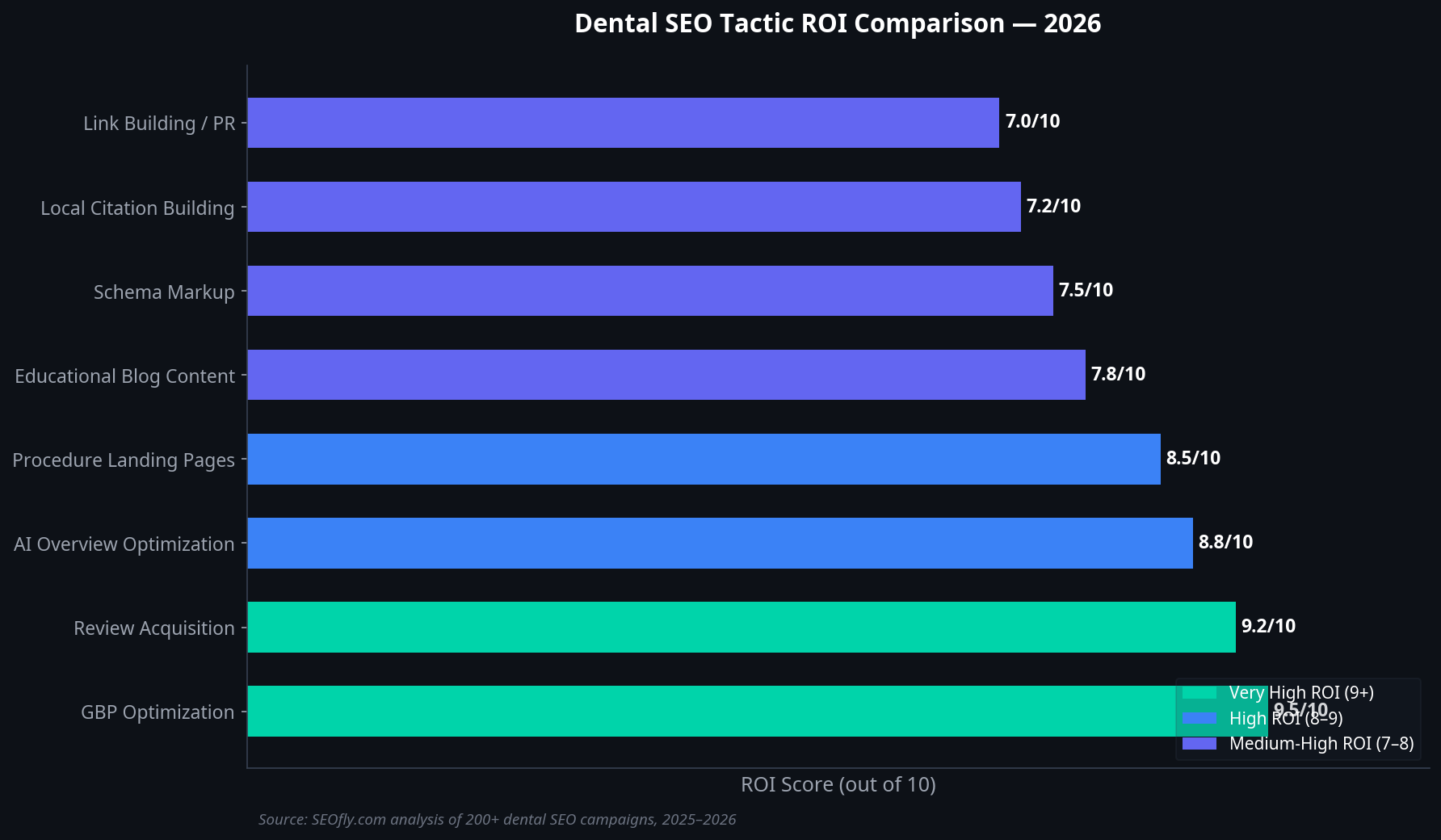
The data in this table reflects patterns observed across hundreds of dental SEO campaigns analyzed by SEO agencies specializing in healthcare over the past two years. The key insight is that the highest-ROI tactics are not necessarily the most expensive or time-consuming ones. Google Business Profile optimization and review acquisition are relatively low-cost interventions that can produce significant ranking improvements within weeks, making them the logical starting point for any practice entering or re-entering the SEO investment cycle.
For practices in competitive urban markets — cities like New York, Los Angeles, Chicago, or Miami — link building and digital PR become essential differentiators. When dozens of dental practices are all executing solid on-page and GBP optimization, the practices with the strongest backlink profiles from authoritative local and industry sources will dominate. A 2025 Ahrefs study found that the number one ranking page in any given Google search has, on average, 3.8 times more backlinks than pages ranking in positions two through ten.
How Should Dentists Target High-Value Procedures Like Implants and Cosmetic Dentistry?
Direct Answer: Dentists should create dedicated, deeply optimized landing pages for each high-value procedure, targeting both transactional keywords and the specific questions patients ask before committing to expensive treatments.
High-value procedures require a different SEO approach than general dentistry services because the patient journey is longer and more research-intensive. A patient considering dental implants will typically spend two to four weeks researching before making their first contact with a practice. During that research period, they will ask questions about cost, recovery time, candidacy requirements, risks, and provider qualifications. The practice whose website answers all of those questions comprehensively — and does so in a way that builds trust — will capture a disproportionate share of those high-intent patients.
An implant landing page built for 2026 should include the procedure's full description, candidacy criteria, a transparent discussion of cost ranges, information about financing options, the dentist's specific credentials and case volume, authentic patient testimonials, and a clear call to action for a consultation. It should be supported by FAQ schema markup so that specific questions appear as rich results in Google. It should also be internally linked to supporting blog posts that answer related long-tail queries, such as "dental implants vs. dentures" or "are dental implants covered by insurance."
According to data from Semrush's Keyword Overview tool, the keyword "dental implants cost" receives over 450,000 monthly searches in the United States alone, making it one of the highest-volume commercial intent keywords in the entire healthcare vertical. Practices that rank on page one for this keyword and its variants can expect a substantial and consistent flow of high-intent inquiries.
FAQ: Dental Practice SEO in 2026
How long does dental SEO take to show results?
Most dental practices begin to see measurable improvements in local rankings and website traffic within three to six months of implementing a comprehensive SEO strategy. Google Business Profile optimizations and review acquisition can produce results in as little as four to eight weeks, while competitive organic rankings for high-value procedure keywords typically require six to twelve months of sustained effort. The timeline depends heavily on the competitiveness of the local market, the starting condition of the website, and the consistency of execution.
How much should a dental practice budget for SEO?
The appropriate SEO budget for a dental practice varies based on market size, competition, and growth goals. In mid-sized markets, practices typically invest between $1,500 and $3,000 per month for a full-service SEO engagement. In highly competitive urban markets, budgets of $4,000 to $8,000 per month are common among practices targeting high-value procedures. When evaluated against the lifetime value of a single implant or cosmetic patient — often $5,000 to $20,000 or more — even a premium SEO investment typically delivers a strong return within the first year.
Is paid search (Google Ads) better than SEO for dental patient acquisition?
Paid search and SEO serve different roles in a dental marketing strategy. Google Ads can generate immediate visibility and are particularly effective for emergency dental queries or new practice launches. However, the cost per click for dental keywords is among the highest of any industry, with terms like "dental implants" averaging $8 to $15 per click in competitive markets. SEO, by contrast, builds compounding organic visibility that does not require ongoing per-click expenditure. The most effective dental practices use both channels, with paid search providing short-term volume while SEO builds long-term dominance.
What role does schema markup play in dental SEO?
Schema markup is structured data code added to a website that helps search engines understand the content and context of each page. For dental practices, relevant schema types include LocalBusiness, Dentist, FAQPage, Review, and MedicalProcedure. Implementing schema markup correctly increases the likelihood of earning rich results in Google — including FAQ dropdowns, star ratings, and enhanced local listings — and significantly improves the chances of being cited in AI overviews. A 2024 study by Schema.org found that pages with properly implemented schema markup rank on average four positions higher than comparable pages without it.
How important is mobile optimization for dental SEO in 2026?
Mobile optimization is non-negotiable for dental SEO in 2026. Google has operated on a mobile-first indexing model since 2021, meaning it evaluates and ranks websites based on their mobile version. More practically, over 70% of local dental searches now occur on mobile devices, according to Google's 2025 Local Search Insights report. A website that loads slowly, displays incorrectly on smartphones, or makes it difficult to tap a phone number or book an appointment will lose patients and rankings simultaneously. Mobile page speed, tap-target sizing, and simplified appointment booking flows are all critical components of a competitive dental website.
Conclusion: The Practices That Invest in SEO Now Will Own Their Markets in 2026 and Beyond
The dental practices acquiring the most high-value patients in 2026 are not the ones with the biggest advertising budgets or the most followers on social media. They are the ones that have built authoritative, technically excellent digital presences that earn the trust of both search engines and prospective patients. They have optimized their Google Business Profiles, built procedure-specific landing pages, created genuinely helpful content, earned hundreds of positive reviews, and structured their websites to appear in AI overviews.
The compounding nature of SEO means that every month of consistent investment builds on the last. A practice that begins executing a comprehensive dental SEO strategy today will have a meaningful competitive advantage over practices that delay. Conversely, every month spent relying solely on paid advertising, word-of-mouth, or outdated marketing tactics is a month of organic authority that cannot be recovered.
The data is unambiguous: organic search is where high-value dental patients begin their journey, and the practices that meet them there with authority and relevance will win their business. If your practice is not currently investing in a data-driven, comprehensive SEO strategy, the cost of inaction is measured in the patients you are already losing to competitors who are.
Don't Let Competitors Dominate Your Market. Google's AI updates are rewarding early adopters. The longer you wait, the harder it becomes to catch up. Schedule your strategy call with SEOfly today before your local competitors lock in the top spots.
Ready to dominate local search and attract more high-value patients to your dental practice? Visit SEOfly.com to learn how our dental SEO specialists can build a custom strategy for your market.