
The home remodeling industry is in the middle of a seismic shift. Homeowners planning $50,000 to $500,000 renovations are no longer flipping through print directories or relying solely on word-of-mouth referrals. They are opening Google, typing highly specific queries, and making shortlist decisions before they ever pick up a phone. For general contractors and design-build firms, this behavioral change represents both an enormous opportunity and a very real threat — because if your competitors are showing up in organic search and AI-generated overviews while you are not, they are capturing the discovery moment that drives your entire sales pipeline.
According to the Home Improvement Research Institute, the U.S. home improvement market surpassed $485 billion in 2024 and is projected to reach $620 billion by 2027. A significant share of that spend is driven by homeowners who begin their contractor search online. The contractors who understand how to position themselves in that search environment are not just getting more leads — they are getting better leads, from clients who already understand the scope and cost of high-end renovation work.
This guide breaks down the specific SEO and answer-engine optimization (AEO) strategies that elite general contractors are using in 2026 to dominate search results, appear in AI overviews, and consistently close high-ticket remodeling projects.
Why Is Organic Search the Most Valuable Channel for High-Ticket Remodeling Leads?
Direct Answer: Organic search captures homeowners at the highest point of intent — when they are actively researching contractors and project costs — making it the most cost-effective channel for acquiring $50k+ remodeling clients compared to paid advertising or referral networks.
High-ticket renovation clients behave differently from homeowners looking for a quick bathroom touch-up. They research extensively. A homeowner planning a $200,000 whole-home renovation may spend four to eight weeks reading content, comparing contractors, reviewing portfolios, and studying project cost breakdowns before reaching out to a single firm. During that research window, organic search is the primary vehicle through which they discover, evaluate, and shortlist contractors.
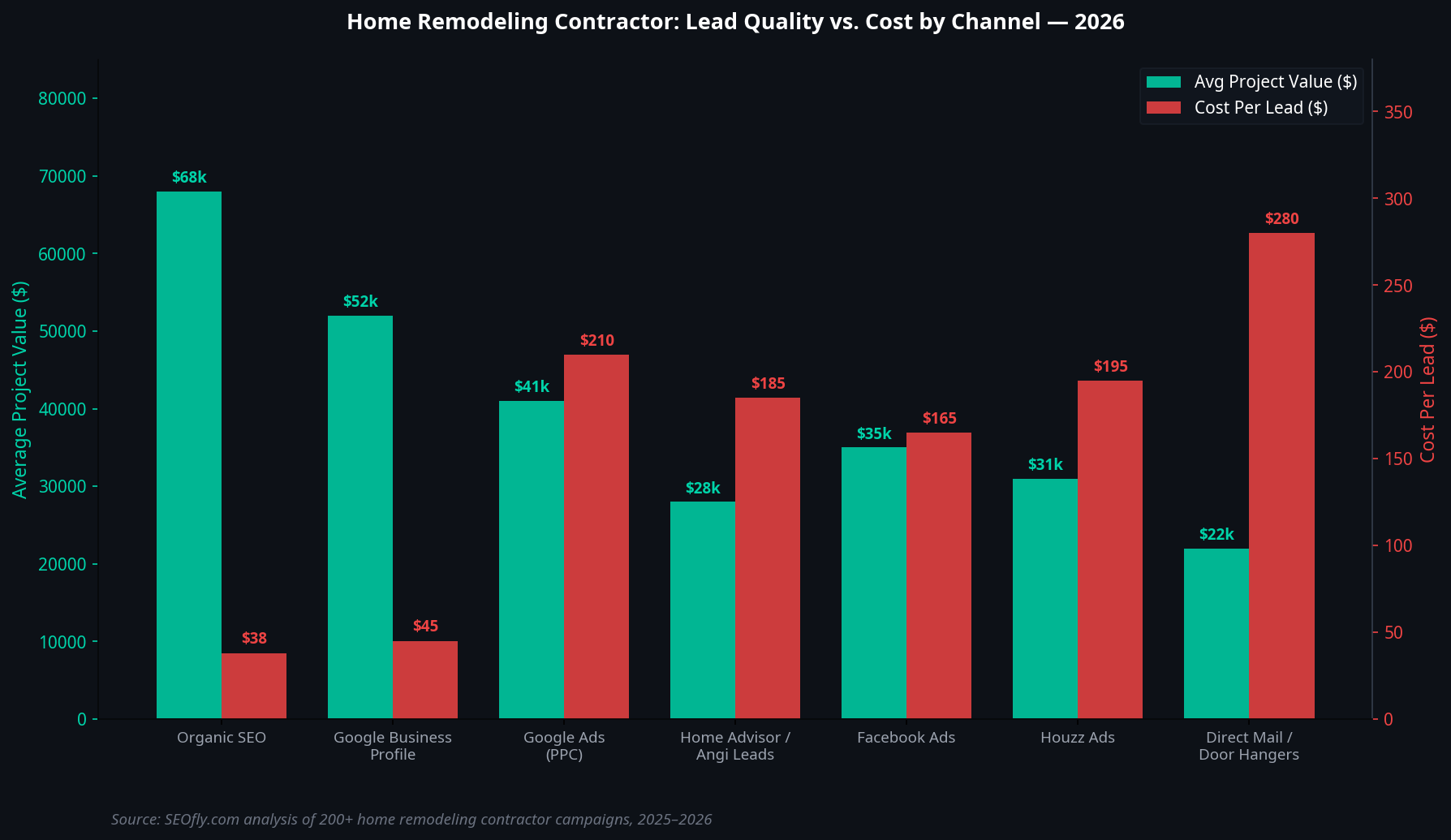
Paid search has its place in a diversified marketing strategy, but it comes with a structural problem for high-ticket services: the cost-per-click for competitive remodeling terms in major metropolitan markets has climbed to $25 to $75 per click in 2025, according to WordStream industry benchmarks. A contractor spending $5,000 per month on Google Ads might generate 70 to 200 clicks — a fraction of the traffic volume that a well-optimized organic presence can deliver consistently, month after month, without ongoing ad spend.
More importantly, research by BrightEdge consistently shows that organic search drives approximately 53% of all website traffic across industries, while paid search accounts for roughly 15%. For home services specifically, organic and local pack results capture the majority of high-intent clicks. The contractors who invest in SEO are building an asset that compounds over time, while those relying exclusively on paid channels are renting visibility they lose the moment their budget stops.
The emergence of AI-powered search experiences — including Google's AI Overviews, Perplexity, and ChatGPT's browsing capabilities — has added another dimension. These systems pull authoritative, well-structured content to generate direct answers for users. Contractors whose websites contain detailed, trustworthy information about renovation processes, costs, and timelines are now appearing inside AI-generated responses, a placement that carries significant credibility with research-oriented, high-budget homeowners.
What Does a High-Ticket Remodeling SEO Strategy Actually Look Like in 2026?
Direct Answer: A winning remodeling SEO strategy in 2026 combines local authority building, intent-matched content across the full buyer journey, technical site health, and structured data markup to capture both traditional search rankings and AI overview placements.
Get Your Free Contractor SEO Audit: Find out exactly which high-ticket renovation keywords your competitors are ranking for — and how to beat them. Claim your free SEO audit from SEOfly today.
The days of targeting a handful of generic keywords like "general contractor near me" and calling it an SEO strategy are over. The contractors winning high-ticket projects in 2026 are operating with a multi-layered approach that addresses every stage of the homeowner's decision-making process.
The foundation is keyword strategy built around buyer intent. High-ticket remodeling clients ask questions that reveal their sophistication and budget. They search for terms like "whole home renovation cost breakdown," "design-build firm vs. general contractor," "kitchen remodel timeline 6 months," and "luxury bathroom addition ROI." These long-tail, intent-rich queries have lower search volume than generic terms but dramatically higher conversion rates because the people typing them are serious buyers.
According to Ahrefs data, long-tail keywords with four or more words account for approximately 70% of all search queries. For contractors, this means the bulk of high-value search traffic lives in specific, detailed queries — not in the broad, competitive terms that most firms mistakenly chase. A design-build firm in Chicago that creates comprehensive content around "gut renovation cost per square foot Chicago" or "historic home renovation contractor Chicago" will attract far more qualified prospects than one optimizing exclusively for "contractor Chicago."
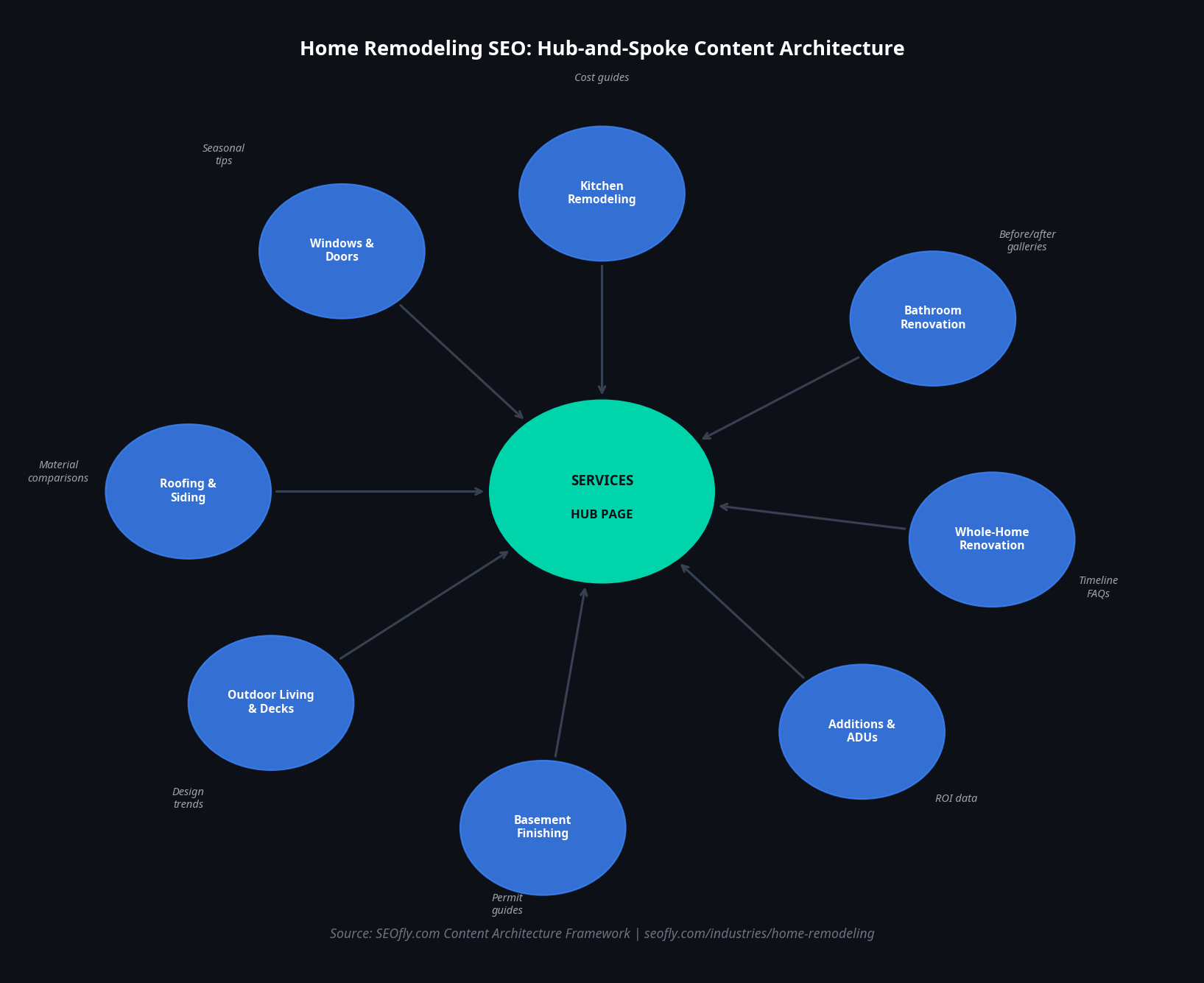
Content architecture matters enormously. The most successful remodeling firms in 2026 are building what SEO professionals call topic clusters — a central pillar page covering a broad subject like kitchen remodeling, supported by a network of detailed cluster pages addressing specific subtopics: cabinet refacing versus replacement, kitchen island addition costs, permit requirements for kitchen expansions, and so on. This structure signals topical authority to search engines and creates multiple entry points for homeowners at different stages of their research.
Technical SEO cannot be overlooked either. Core Web Vitals scores, mobile responsiveness, HTTPS security, and page speed directly influence both rankings and user experience. A contractor's website that loads in under two seconds and passes Google's Core Web Vitals assessment converts visitors at a measurably higher rate than a slow, outdated site — and ranks higher in the process.
How Are AI Overviews Changing the Way Contractors Get Discovered?
Direct Answer: Google's AI Overviews now appear for a significant percentage of home remodeling queries, and contractors whose content is structured with clear answers, authoritative data, and schema markup are being featured in these placements, generating visibility that bypasses traditional blue-link competition.
Google's AI Overviews, which rolled out broadly in 2024 and have continued to expand through 2025 and into 2026, represent one of the most significant changes to search visibility in years. For home remodeling queries, AI Overviews frequently appear at the top of the search results page, summarizing information about costs, processes, timelines, and contractor selection criteria. The sources cited within these overviews receive a form of implicit endorsement that carries substantial weight with research-oriented homeowners.
To earn placement in AI Overviews, contractors need to think like answer engines, not just search engines. This means structuring content with clear, direct answers to specific questions, using headers that mirror the questions homeowners actually ask, and supporting every claim with verifiable data or expert insight. Google's systems are designed to surface content that is genuinely helpful, authoritative, and trustworthy — the same qualities that high-budget homeowners are looking for in a contractor.
Schema markup plays a critical role in this environment. Implementing LocalBusiness schema, Service schema, FAQPage schema, and Review schema helps search engines and AI systems understand the structure and context of your content. According to a 2024 study by Schema App, pages with structured data markup are significantly more likely to appear in rich results and AI-generated summaries than pages without it. For contractors, this means adding schema to service pages, project case studies, and FAQ sections is no longer optional — it is a core component of competitive SEO.
The practical implication is that contractors who invest in creating genuinely informative, well-structured content — detailed project cost guides, step-by-step renovation process explanations, honest timelines, and transparent pricing frameworks — are being rewarded with AI Overview placements that their competitors, who publish thin or generic content, simply cannot access.
How Does Local SEO Specifically Drive $50k+ Remodeling Projects?
Direct Answer: Local SEO — encompassing Google Business Profile optimization, geo-targeted content, and localized citation building — directly connects high-budget homeowners with contractors in their market, and firms with strong local authority consistently appear in both the local map pack and AI-generated local recommendations.
For general contractors, local SEO is not a subset of SEO strategy — it is the core of it. The overwhelming majority of remodeling clients hire contractors within a defined geographic radius, which means appearing prominently in local search results is directly tied to revenue generation. The Google Local Pack, which displays three business listings prominently above organic results for location-based queries, captures a disproportionate share of clicks for high-intent searches like "kitchen remodel contractor [city]" or "design-build firm [neighborhood]."
Google Business Profile (GBP) optimization is the starting point. Contractors with complete, accurate, and actively managed GBP listings — including high-quality project photos, consistent business information, regular posts, and a robust portfolio of authentic reviews — consistently outperform competitors with neglected profiles. According to BrightLocal's 2024 Local Consumer Review Survey, 87% of consumers read online reviews for local businesses, and the average consumer reads ten reviews before forming a trust opinion. For a $150,000 renovation project, a homeowner will read every review available.
Review velocity and recency matter significantly to Google's local ranking algorithm. A contractor with 200 reviews averaging 4.8 stars, with new reviews posted consistently over the past six months, will outrank a competitor with 50 reviews averaging 5.0 stars that were all posted two years ago. Building a systematic process for requesting and responding to reviews is not just a reputation management tactic — it is a direct local SEO lever.
Geo-targeted content on the website itself is equally important. Creating dedicated service area pages for each city or neighborhood you serve — pages that go beyond a simple list of zip codes and instead provide genuinely useful local context, such as information about local permit processes, neighborhood-specific renovation trends, or case studies from projects completed in that area — builds the geographic relevance signals that drive local rankings.
What Content Types Convert High-Budget Remodeling Clients Most Effectively?
Direct Answer: Detailed project cost guides, before-and-after case studies with transparent scope and budget information, and process-oriented content that reduces homeowner uncertainty are the highest-converting content formats for attracting and closing $50k+ remodeling clients through organic search.
Understanding what content actually converts high-ticket clients requires understanding their psychology. A homeowner considering a $300,000 whole-home renovation is not looking for a sales pitch — they are looking for evidence of competence, transparency, and trustworthiness. The content that serves this need most effectively is content that educates, demonstrates expertise, and reduces the anxiety associated with a major financial commitment.
Project cost guides are among the most powerful tools in a contractor's content arsenal. A comprehensive guide to kitchen remodeling costs that breaks down labor, materials, permitting, design fees, and contingency budgets — with honest ranges tied to scope and finish level — positions the contractor as a trusted expert while simultaneously attracting homeowners who are actively budgeting for a project. According to HubSpot's State of Marketing Report, educational content generates three times more leads than outbound marketing while costing 62% less.
Detailed case studies are equally compelling. A well-executed case study that walks through a specific project — the client's goals, the challenges encountered, the design decisions made, the timeline, the budget, and the final result — does something that no amount of generic marketing copy can achieve: it makes the homeowner's own project feel real and achievable. Case studies featuring projects in the $100,000 to $500,000 range specifically attract clients at that budget level, creating a self-selection effect that improves lead quality.
Process content — articles and pages that explain exactly how a design-build firm manages a project from initial consultation through final walkthrough — addresses one of the primary concerns that holds high-budget homeowners back from moving forward: fear of the unknown. Contractors who demystify the renovation process through transparent, detailed content build trust before the first conversation ever takes place.
How Do Remodeling SEO Strategies Compare Across Different Business Models?
Direct Answer: Design-build firms, specialty remodelers, and general contractors each require a distinct SEO approach based on their service scope, average project value, and target client profile, and understanding these differences is essential to building a strategy that attracts the right leads.
Free Download: Get the SEOfly 2026 Home Remodeling Contractor SEO Checklist — the 47-point framework our top-performing contractor clients use to rank for high-ticket renovation keywords. Download it free here.
| Business Model | Primary SEO Focus | Best Content Types | Avg. Target Keyword Intent | Local vs. National |
|---|---|---|---|---|
| Design-Build Firm | Brand authority + portfolio | Case studies, design process guides | High-intent, brand-aware | Primarily local |
| General Contractor | Service range + trust signals | Cost guides, project timelines | Informational + transactional | Local with regional reach |
| Specialty Remodeler (Kitchen/Bath) | Niche topical authority | Comparison content, material guides | Transactional + informational | Hyper-local |
| Luxury Home Renovator | Exclusivity + portfolio | Visual case studies, architect partnerships | Brand + aspirational | Local + affluent zip targeting |
| Design-Assist Contractor | Process transparency | Collaboration guides, client testimonials | Informational | Local |
The table above illustrates that while all remodeling businesses benefit from SEO, the specific tactics, content types, and keyword strategies that drive the best results vary significantly by business model. A luxury home renovator competing for $500,000+ projects needs a fundamentally different content strategy than a specialty kitchen remodeler targeting $75,000 to $150,000 projects, even though both benefit from local SEO, review management, and technical site optimization.
Design-build firms, in particular, have a significant content opportunity that many underutilize: the design process itself. Homeowners considering a design-build engagement are often unfamiliar with how the model works and how it differs from hiring an architect and contractor separately. Firms that create detailed, authoritative content explaining the design-build process, its advantages, its cost implications, and its timeline benefits are capturing a highly qualified audience that is specifically researching this model — and is therefore much further along in the buying process than a generic "contractor" searcher.
What Metrics Should Contractors Track to Measure Remodeling SEO Performance?
Direct Answer: Contractors should prioritize tracking organic lead volume, keyword ranking progression for high-intent terms, Google Business Profile engagement metrics, and conversion rate from organic traffic — not just overall traffic volume — to accurately measure SEO return on investment.
Measuring SEO performance in the home remodeling context requires a focus on business outcomes, not vanity metrics. Total website traffic is a largely meaningless number if it does not translate into qualified inquiries from homeowners with appropriate budgets and project scope. The metrics that matter are those that connect organic search activity directly to revenue-generating opportunities.
Organic lead volume — the number of phone calls, contact form submissions, and consultation requests that originate from organic search — is the primary KPI. This requires proper conversion tracking setup in Google Analytics 4, including call tracking integration (tools like CallRail are widely used in the contractor space) and goal configuration for form submissions. Without this infrastructure, it is impossible to accurately attribute leads to their source.
Keyword ranking progression for a defined set of high-intent target terms provides a leading indicator of future lead volume. Tracking rankings for 20 to 50 carefully selected keywords — covering both informational research terms and transactional queries — gives contractors a forward-looking view of their organic visibility trajectory. According to Semrush data, websites that rank in positions one through three for a given keyword capture approximately 54% of all clicks for that query, making top-three rankings the meaningful threshold for traffic impact.
Google Business Profile metrics — specifically profile views, direction requests, website clicks, and call button clicks — are critical for local SEO measurement. These metrics directly reflect the visibility and engagement of your local search presence, and tracking them monthly reveals whether your local optimization efforts are moving the needle.
FAQ: Home Remodeling SEO for General Contractors
How long does it take for remodeling SEO to generate leads?
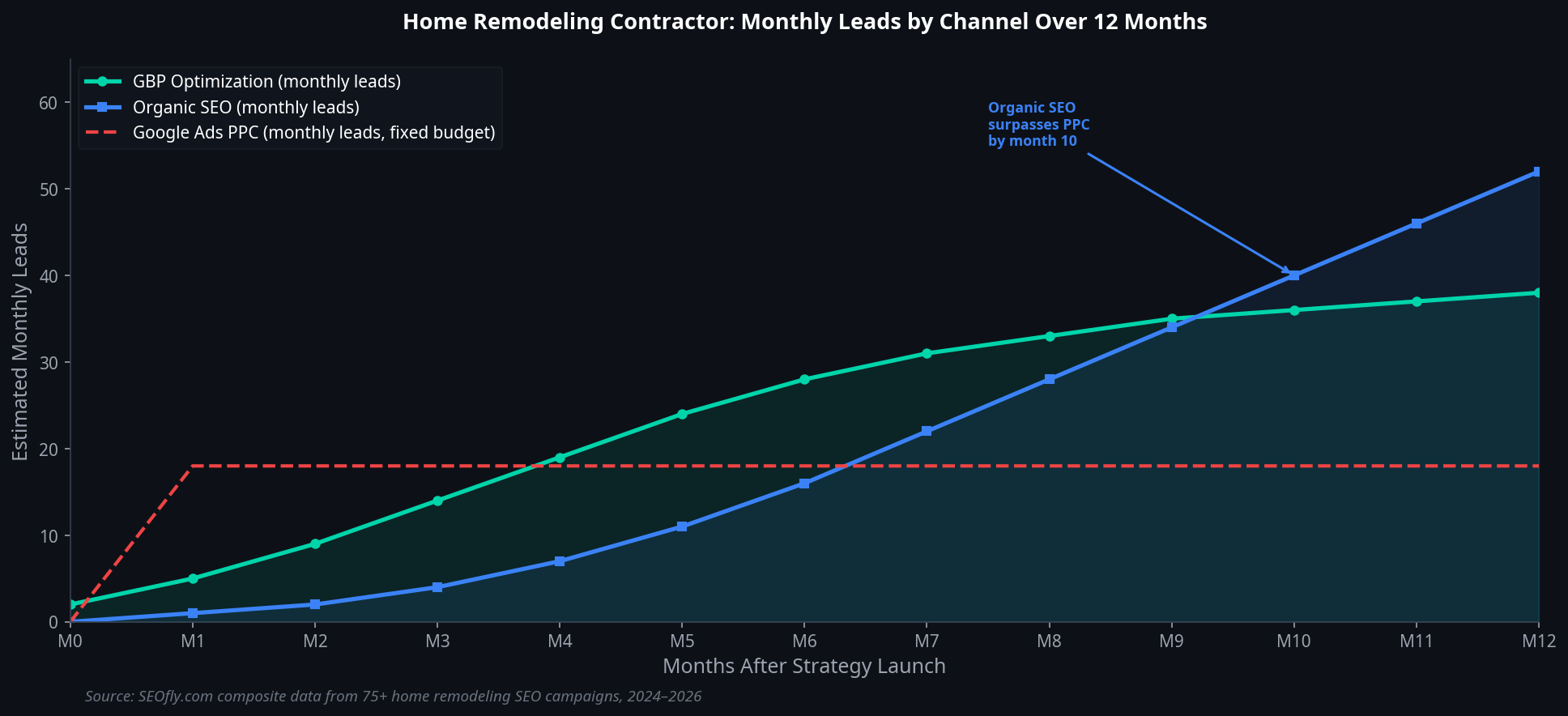
Most contractors begin seeing measurable improvements in organic traffic and local visibility within three to six months of implementing a comprehensive SEO strategy. However, competitive markets and high-ticket keyword targets may require six to twelve months to achieve top-three rankings. SEO is a compounding investment — the results build over time and become increasingly valuable as your authority grows.
Is Google Ads or SEO better for generating high-ticket remodeling leads?
Both channels have merit, but SEO delivers a superior long-term return on investment. Paid search generates immediate visibility but requires continuous spend and becomes increasingly expensive in competitive markets. SEO builds durable organic authority that generates leads without per-click costs. The most effective strategy for most contractors combines both, using paid search for immediate lead generation while building organic presence for long-term cost efficiency.
How important are online reviews for remodeling SEO?
Online reviews are critically important for both local SEO rankings and conversion rates. Google's local ranking algorithm explicitly considers review quantity, recency, and rating in determining local pack placement. Beyond rankings, reviews are a primary trust signal for high-budget homeowners evaluating contractors. Contractors should implement a systematic process for requesting reviews from satisfied clients immediately after project completion.
What is the difference between SEO and AEO for contractors?
SEO (Search Engine Optimization) focuses on improving rankings in traditional search results, while AEO (Answer Engine Optimization) focuses on structuring content to appear in AI-generated answers, featured snippets, and voice search responses. In 2026, both are essential. AEO requires writing in a question-and-answer format, using clear headers, providing direct and concise answers to specific questions, and implementing structured data markup. Contractors who optimize for both SEO and AEO maximize their visibility across the full spectrum of modern search experiences.
Should general contractors have separate pages for each service or one combined services page?
Separate, dedicated pages for each core service are strongly recommended from an SEO perspective. A single combined services page cannot rank competitively for multiple distinct service queries. Dedicated pages for kitchen remodeling, bathroom renovations, whole-home remodels, additions, and other specific services allow each page to be optimized for its own set of keywords, accumulate its own backlinks, and build topical relevance independently. This structure consistently outperforms combined pages in competitive markets.
How do I optimize my contractor website for AI Overviews specifically?
To optimize for AI Overviews, focus on creating content that directly answers specific questions homeowners ask about your services. Use clear H2 and H3 headers framed as questions, provide concise direct answers in the first one to two sentences under each header, support your content with verifiable data and statistics, implement FAQ schema markup, and ensure your website demonstrates E-E-A-T (Experience, Expertise, Authoritativeness, and Trustworthiness) through detailed credentials, certifications, and project evidence.
Your Competitors Are Already Investing in SEO. The contractors winning $100k+ projects in 2026 started their SEO strategy 12 months ago. Don't fall further behind. Schedule your free strategy call with SEOfly now — limited spots available this month.
Conclusion: Building an SEO Engine That Consistently Wins High-Ticket Projects
The contractors winning the most valuable remodeling projects in 2026 are not simply the best builders in their markets — they are the most visible, the most authoritative, and the most trusted in the digital spaces where high-budget homeowners make their decisions. Organic search and AI-powered discovery have fundamentally changed the competitive landscape, and the firms that treat SEO as a core business investment rather than an optional marketing expense are pulling away from the competition in a way that will be very difficult to reverse.
The strategy is clear: build topical authority through intent-matched content that serves every stage of the buyer journey, optimize your local presence with a managed Google Business Profile and a systematic review strategy, implement technical SEO and structured data to earn AI Overview placements, and measure everything against business outcomes rather than vanity metrics. None of this happens overnight, but every month of consistent execution compounds into a more powerful, more durable competitive advantage.
If you are ready to build an SEO strategy that consistently attracts and converts high-ticket remodeling clients, the team at SEOfly specializes in helping general contractors, design-build firms, and home remodeling businesses dominate their local markets through data-driven organic search strategies. Contact us today for a comprehensive SEO audit and a customized roadmap for your business.