
Meta Title: HVAC Local SEO 2026: Dominate Google Maps & Get Leads (59 chars) Meta Description: Learn how HVAC contractors can dominate Google Maps in 2026. Discover proven local SEO strategies, GBP optimization tips, and AEO tactics for high-intent leads. (159 chars)
The HVAC industry is highly competitive, and when a homeowner's AC breaks down in the middle of a July heatwave or their furnace fails during a winter freeze, they don't spend hours researching. They search for "HVAC repair near me" and call one of the first three businesses they see on Google Maps. If your HVAC company isn't appearing in that coveted Google Map Pack, you are virtually invisible to hundreds of high-intent potential customers every single month. In 2026, relying on word-of-mouth or outdated SEO tactics is no longer sufficient to sustain growth.
Local Search Engine Optimization (SEO) for HVAC contractors is not just about driving website traffic; it is a direct lead generation strategy that connects your business with customers exactly when they need you most. This comprehensive guide will walk you through the most effective HVAC local SEO strategies for 2026, focusing on Google Business Profile (GBP) optimization, Answer Engine Optimization (AEO), review management, and local keyword targeting. By implementing these tactics, you can elevate your visibility, build trust, and turn online searches into booked service calls.
Why is Local SEO Crucial for HVAC Contractors in 2026?
Direct Answer: Local SEO is crucial for HVAC contractors because the majority of emergency service calls originate from the Google Map Pack. Ranking in the top three local results ensures high visibility to homeowners actively seeking immediate heating or cooling solutions, directly driving booked jobs and revenue.
In the fast-paced world of home services, visibility equals credibility. When a user performs a local search, Google prioritizes results based on relevance, distance, and prominence. The Google Map Pack—the block of three local business listings that appears above organic search results—captures the vast majority of clicks. In fact, data indicates that the top three Google Maps listings capture most local clicks, while positions four and below receive almost no engagement [1].
For HVAC contractors, this means that even if your website has excellent content and ranks on page one organically, the Map Pack will still get clicked first. Customers in need of emergency HVAC repairs are typically searching on mobile devices, ready to call immediately, and choosing the first contractor with strong reviews and a complete profile [1]. Therefore, local SEO is the most direct path to capturing these high-intent leads and growing your service business.
Free Resource: Want to see how your current local SEO stacks up against competitors? Get a free, comprehensive SEO audit from SEOfly today and discover how to dominate your local market. Claim your free SEO audit here.
How Do You Optimize a Google Business Profile for HVAC?
Direct Answer: To optimize an HVAC Google Business Profile, select "HVAC Contractor" as the primary category, list all specific services, write a keyword-rich description including service areas, upload high-quality photos regularly, ensure NAP (Name, Address, Phone) consistency, and post weekly updates.
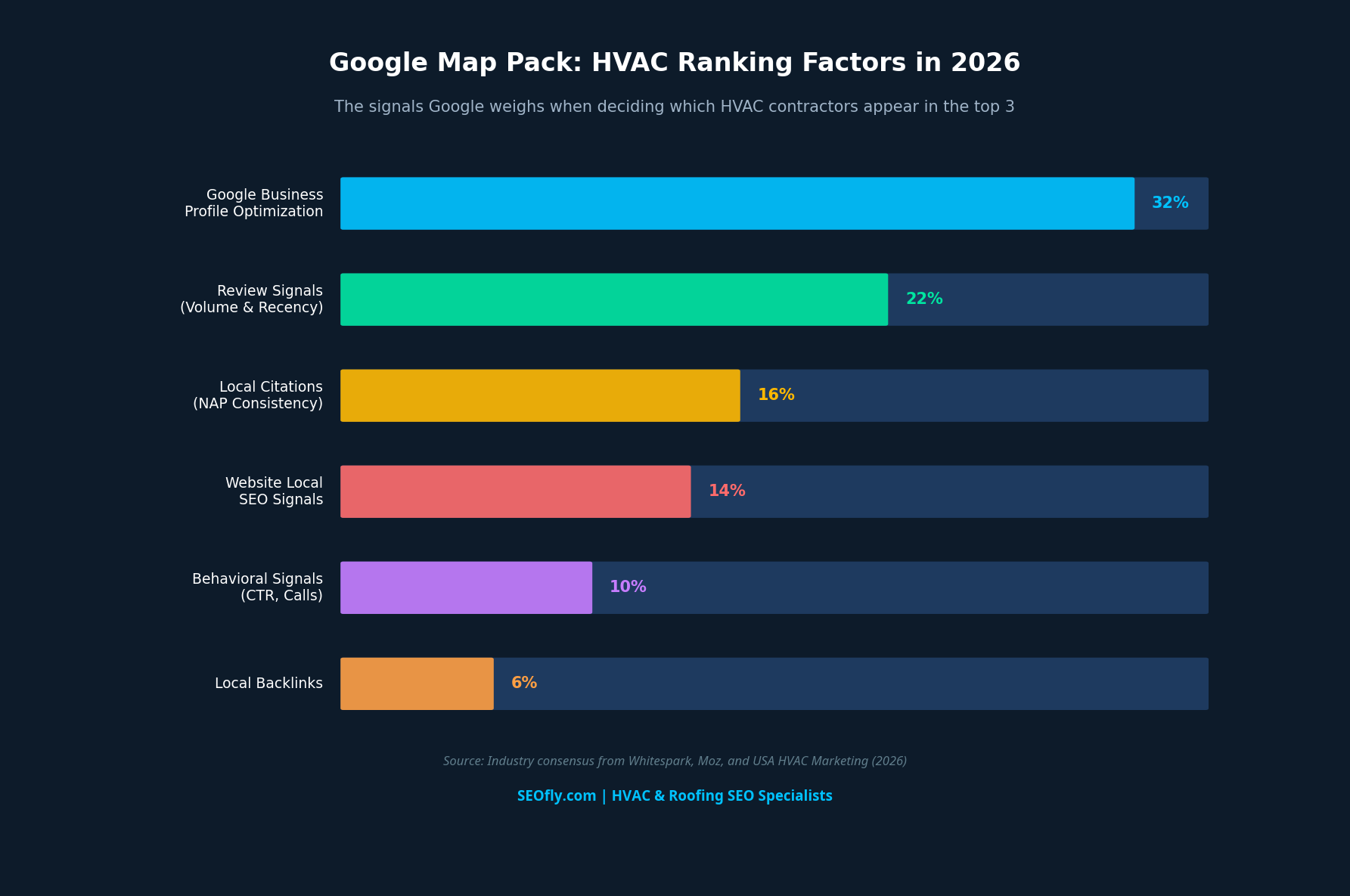
Your Google Business Profile (GBP) is the cornerstone of your local SEO strategy and the single most important ranking factor for Google Maps. According to recent industry data, an optimized profile is the primary driver of local pack visibility [1]. Many contractors create a profile but leave it incomplete, which severely limits their ability to rank against competitors who fully leverage the platform.
To maximize your GBP's potential, start by ensuring your primary category is set accurately to "HVAC Contractor" rather than a generic term like "Air Conditioning Contractor" [1]. Next, meticulously add every service you offer, such as AC repair, furnace installation, heat pump service, duct cleaning, and maintenance plans. Write a comprehensive, keyword-rich business description that naturally incorporates your city name and main services.
Furthermore, clearly define your full service area, including every city and zip code your technicians cover. Visual proof is also critical; upload at least 10 high-quality photos of your team, branded trucks, completed jobs, and office space [1]. Finally, ensure your Name, Address, and Phone number (NAP) are 100% accurate and consistent across all online platforms. Regular activity, such as posting seasonal tips or promotions weekly, signals to Google that your business is active and relevant [1].
What is the Role of Reviews in HVAC Local Rankings?
Direct Answer: Reviews significantly impact HVAC local rankings by signaling trust and prominence to Google. Both the volume and recency of reviews matter; a steady stream of fresh, positive reviews mentioning specific services and locations helps HVAC companies outrank competitors in the Map Pack.
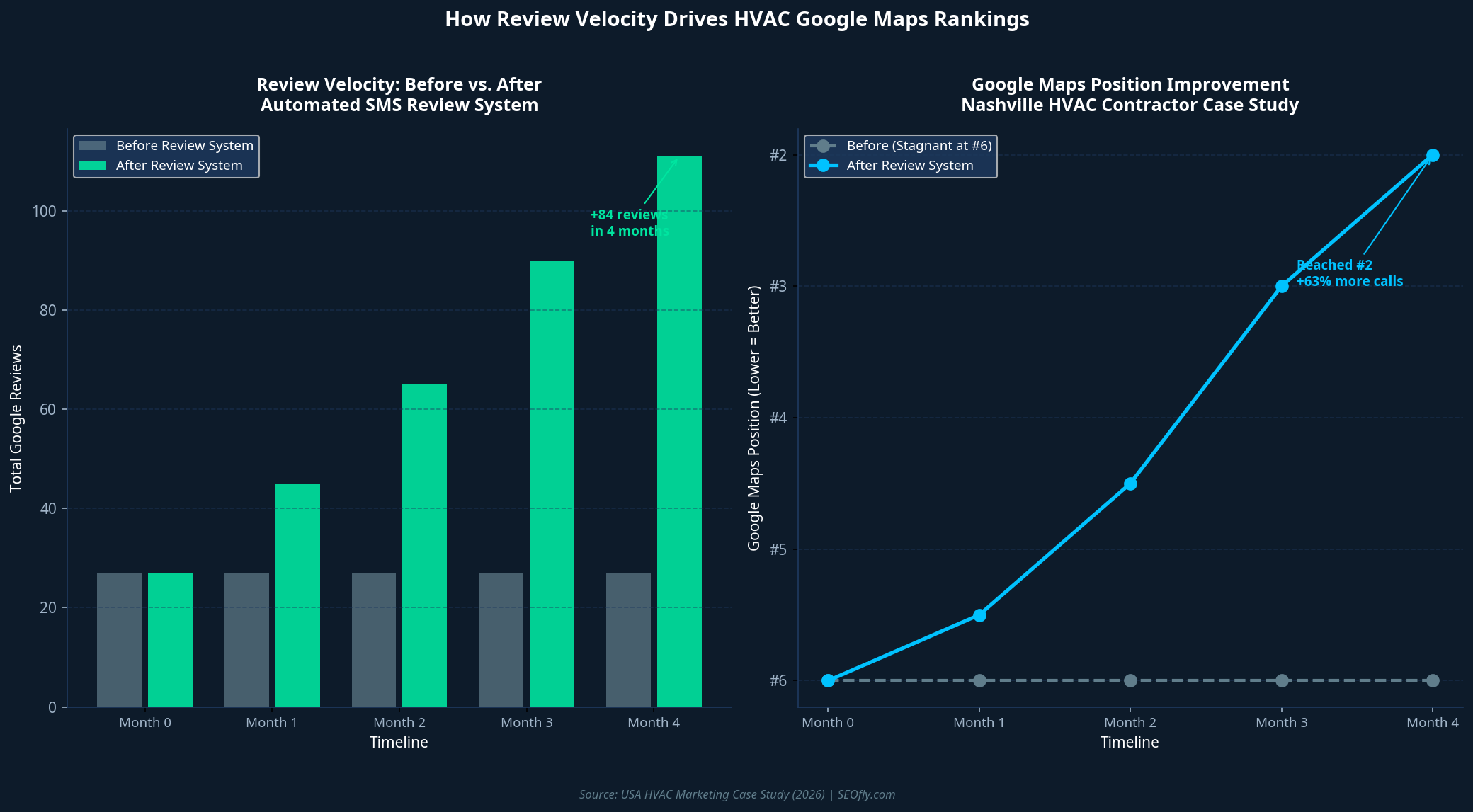
Customer reviews are a powerful local ranking factor and a critical component of building consumer trust. Google evaluates not just your average star rating, but also the total volume of reviews and how recently they were posted. Consumers increasingly value the recency of reviews when choosing a local service provider, meaning an HVAC company with 150 recent reviews at 4.7 stars will often outrank a company with 20 older reviews at 5.0 stars in a competitive market [1].
To consistently generate reviews, implement a systematic approach. Train your technicians to ask for a review immediately after completing a job, capitalizing on the moment when customer satisfaction is highest. Follow up by sending an automated SMS or email with a direct Google review link within two hours of job completion [1].
Equally important is how you manage these reviews. Respond to every review within 24 hours, thanking positive reviewers and professionally addressing any concerns raised in negative feedback [1]. Encourage customers to mention specific services and locations in their reviews (e.g., "Great AC repair in Miami"), as these keywords provide additional context to Google and enhance your relevance for local searches.
| Review Strategy Component | Implementation Tactic | SEO Benefit |
|---|---|---|
| Immediate Request | Train techs to ask in person upon job completion. | Capitalizes on peak customer satisfaction. |
| Automated Follow-up | Send SMS/email with direct link within 2 hours. | Increases conversion rate of review requests. |
| Prompt Response | Reply to all reviews within 24 hours. | Shows active management and builds trust. |
| Keyword Inclusion | Encourage mentioning specific services and cities. | Boosts local relevance and keyword associations. |
How Should HVAC Websites Target Local Keywords?
Direct Answer: HVAC websites should target local keywords by creating dedicated location pages for each city served, optimizing service pages with geo-modifiers, and balancing short-tail terms (e.g., "HVAC repair") with high-intent long-tail phrases (e.g., "emergency AC repair in Orlando").
Your website must work in tandem with your Google Business Profile to confirm your local authority. Google crawls your website to verify that you genuinely serve the areas you claim and that your business is a credible resource. Effective local keyword targeting involves integrating geo-modifiers (city names, neighborhoods, counties) with your core service terms.
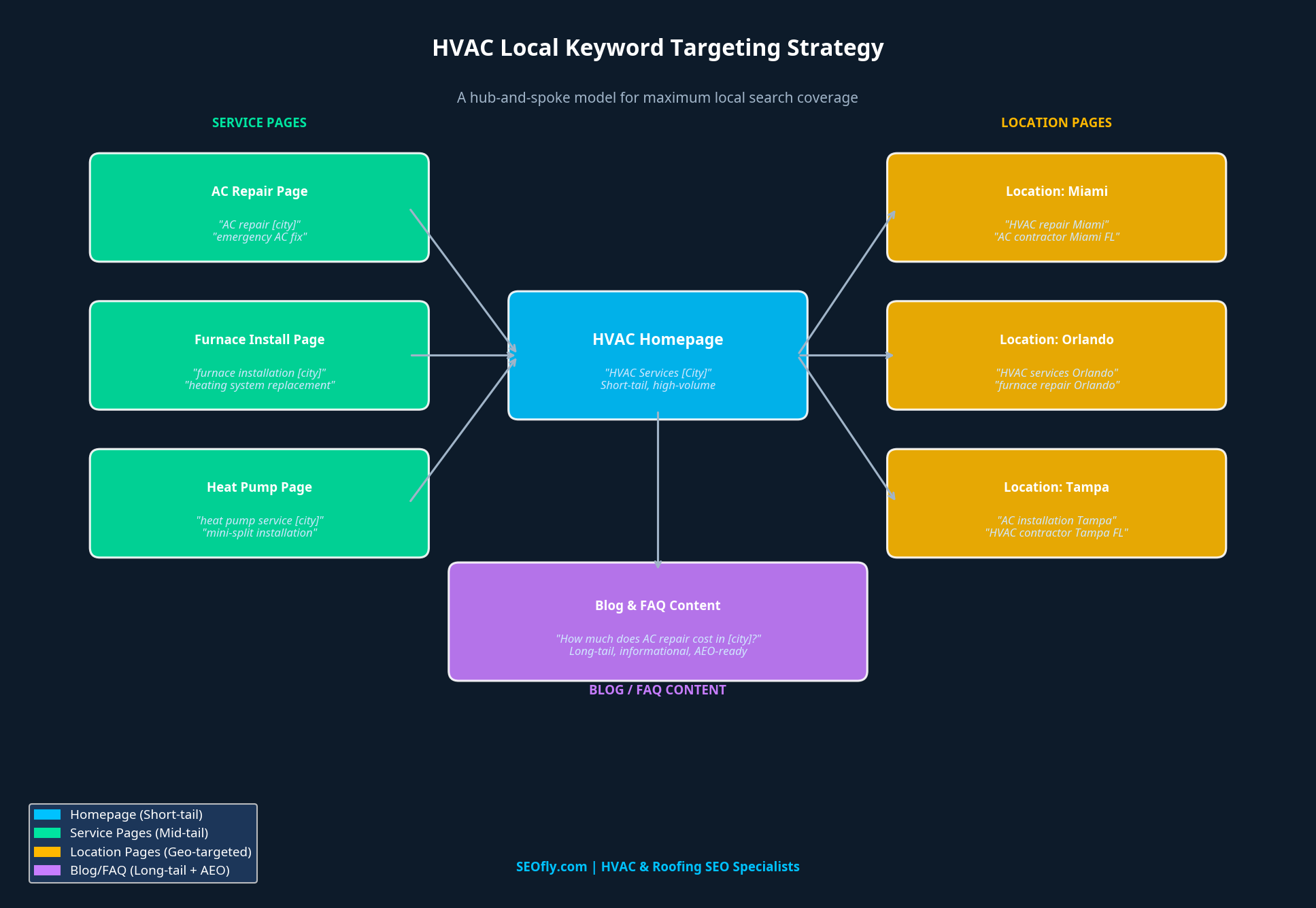
A critical strategy is to create a dedicated location page for every city you serve [1]. Instead of a generic page stating "We serve Phoenix and surrounding areas," a strong location page should explicitly state, "SEOfly provides AC repair, furnace installation, and HVAC maintenance to homeowners in Phoenix, AZ. Our licensed technicians serve the 85001 through 85099 zip codes." [1]. This level of specificity is one of the highest-impact changes most HVAC websites can make to capture localized search traffic.
Additionally, balance your keyword strategy between short-tail and long-tail keywords. Short-tail keywords like "HVAC repair" are highly competitive, while long-tail keywords like "best HVAC repair service in [city]" are more specific, easier to rank for, and often bring in higher-quality leads with clear intent [2]. Ensure your city and service are included in every page title, and embed a Google Map on your contact page to reinforce your local presence [1].
What is Answer Engine Optimization (AEO) for HVAC?
Direct Answer: Answer Engine Optimization (AEO) for HVAC involves structuring website content to directly answer common homeowner questions, enabling AI search engines and voice assistants to pull your content for AI Overviews and direct answers, thereby increasing brand visibility.
As search engines evolve in 2026, AI-powered search and Answer Engine Optimization (AEO) are reshaping how users find local services. AI search platforms now pull local business recommendations directly from Google Maps data and structured website content [1]. When homeowners ask AI platforms "Who are the best HVAC contractors near me?", the recommended businesses are typically those with optimized GBPs, strong review profiles, and content that directly answers user queries [1].
To optimize for AEO, your website content must be clear, authoritative, and structured to provide direct answers. Incorporate detailed FAQ sections on your service pages, addressing common concerns such as "How much does AC repair cost?" or "When should I replace my furnace?" [1]. AI search engines frequently pull directly from these FAQ sections when answering homeowner questions.
Furthermore, ensure your website utilizes proper Schema markup (structured data) to help search engines understand your business details, services, and service areas without ambiguity. The HVAC contractors who optimize for AI search and AEO now will secure those valuable AI recommendations before the competition catches up.
Mid-Post Value Offer: Download our free 2026 HVAC SEO Checklist to ensure your website and GBP are fully optimized for local search and AI Overviews. Download the Checklist Now.
How Do Local Backlinks and Citations Impact HVAC SEO?
Direct Answer: Local backlinks and consistent NAP citations impact HVAC SEO by validating your business's legitimacy and authority. Consistent information across directories prevents Google confusion, while backlinks from local organizations signal community trust and boost Map Pack rankings.
Off-page SEO factors, specifically citations and local backlinks, play a crucial role in validating your business to search engines. A citation is any online mention of your business's Name, Address, and Phone number (NAP). Google cross-references your NAP information across hundreds of directories to confirm you are a legitimate, established local business [1].
If your business name appears differently across listings, or an old phone number is still showing on some platforms, Google gets confused, which can cause your rankings to drop [1]. It is essential to get listed and maintain 100% consistency on platforms like Yelp, Angi, the Better Business Bureau (BBB), local chamber of commerce websites, Apple Maps, and Bing Places [1].
Local backlinks—links from other websites pointing to yours—tell Google that your business is trusted and established in the community. For local SEO, backlinks from local sources carry the most weight. You can earn these by joining local chambers of commerce, getting listed in HVAC equipment supplier directories, sponsoring community events, or being featured on local news and neighborhood blogs [1]. Since many HVAC contractors neglect link building, acquiring even a handful of strong local backlinks can provide a significant competitive advantage.
Conclusion: Securing Your HVAC Market Share in 2026
Ranking on Google Maps and dominating local search in 2026 is not about quick tricks or shortcuts; it is about demonstrating to Google and your future customers that your HVAC business is active, trusted, and genuinely serving the local community. By fully optimizing your Google Business Profile, consistently generating fresh reviews, building accurate local citations, creating dedicated location pages, and adapting to AI search trends through AEO, you can secure top positions in the Map Pack.
These strategies compound over time. The HVAC contractors who commit to a systematic local SEO approach today will see increased Map Pack visibility, higher inbound call volumes, and more booked jobs tomorrow. Don't let your competitors answer the calls that should be yours.
Ready to dominate your local market and generate high-intent HVAC leads? Stop losing jobs to lower-quality competitors who simply have better SEO. As a leading HVAC & Roofing SEO agency, SEOfly provides comprehensive, custom strategies tailored for home service contractors. Whether you are expanding your commercial roofing business or scaling residential HVAC, we handle your digital growth while you focus on keeping your customers comfortable.
Urgent Exit CTA: Google's local search algorithms are updating rapidly. Don't wait until your competitors push you off the Map Pack. Contact SEOfly today to secure your local market share before the busy season begins. We also offer specialized SEO services for plastic surgeons, financial advisors, personal injury attorneys, and home remodeling contractors.
Frequently Asked Questions (FAQ)
Q: How long does it take to see results from HVAC local SEO? A: In smaller markets, you may see movement in 45 to 90 days with consistent action. Mid-size markets typically take 3 to 4 months, while highly competitive metro areas may require 4 to 6 months to reach the top 3 positions on Google Maps [1].
Q: What is the most important ranking factor for Google Maps? A: A fully optimized Google Business Profile (GBP) is the most critical ranking factor. This includes having the correct primary category, a complete list of services, accurate NAP information, high-quality photos, and consistent weekly posts [1].
Q: Why are my competitors ranking higher on Google Maps even though I have better reviews? A: Google evaluates multiple factors, including proximity, relevance, and prominence. Your competitor might have a more optimized GBP, better NAP consistency across directories, stronger local backlinks, or a website with dedicated location pages that signal stronger relevance to Google [1].
Q: Do I need a separate page for every city I serve? A: Yes, creating dedicated location pages for each city you serve is highly recommended. It allows you to target specific geo-modifiers and explicitly tells Google that you provide services in those specific areas, improving your chances of ranking in local searches [1].
Q: How does Answer Engine Optimization (AEO) differ from traditional SEO? A: While traditional SEO focuses on ranking web pages in search engine results, AEO focuses on structuring content to directly answer user queries, making it easily extractable by AI search engines and voice assistants for direct answers and AI Overviews [1].
References
[1] USA HVAC Marketing. "How to Rank Your HVAC Business on Google Maps in 2026." https://usahvacmarketing.com/how-to-rank-hvac-business-google-maps-2026/ [2] RS Gonzales. "101 HVAC SEO Keywords to Drive More Traffic To Your Website in 2026." https://rsgonzales.com/blog/hvac-seo-keywords/