The medical spa industry is experiencing explosive growth, with the global market projected to reach $36.9 billion by 2028 [1]. However, as demand for Botox, dermal fillers, and non-invasive treatments surges, so does local competition. For med spa owners and marketers, the challenge in 2026 is no longer just generating awareness—it is capturing high-intent patients efficiently before competitors do.
In this Answer Engine Optimization (AEO) era, traditional "rank and hope" strategies are obsolete. Med spas must adopt a robust, data-driven Search Engine Optimization (SEO) strategy to lower their Cost Per Acquisition (CPA) and maximize Return on Investment (ROI). This comprehensive guide breaks down exactly how med spas can dominate local search, optimize their Google Business Profiles, and leverage high-intent keywords to secure more booked appointments in 2026.
Why Is Med Spa SEO Critical for Growth in 2026?
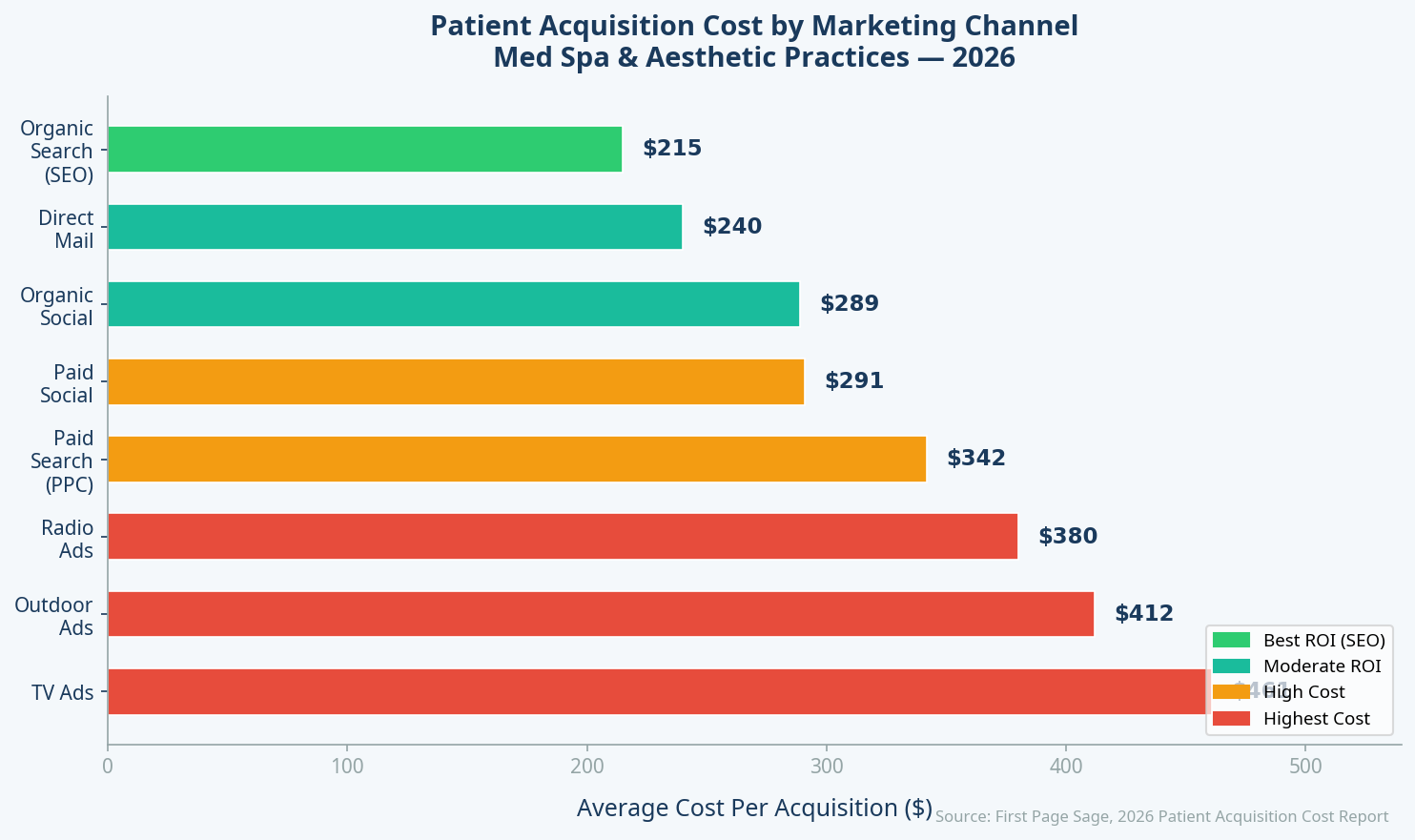
Direct Answer: Med spa SEO is critical in 2026 because organic search generates the lowest patient acquisition cost ($215) compared to paid search ($342) and paid social ($291), while organic traffic converts at a higher rate (4–7%) than paid traffic (2–5%) due to the self-selected, high-intent nature of searchers.
The landscape of aesthetic marketing has fundamentally shifted. For a deeper look into clinical data, see our report on the 2026 State of Plastic Surgery SEO. According to recent data, the average patient acquisition cost for a med spa stands at $285 [3]. However, the efficiency of your marketing channels dictates whether you operate below or above this benchmark.
The Compounding Value of Organic Search
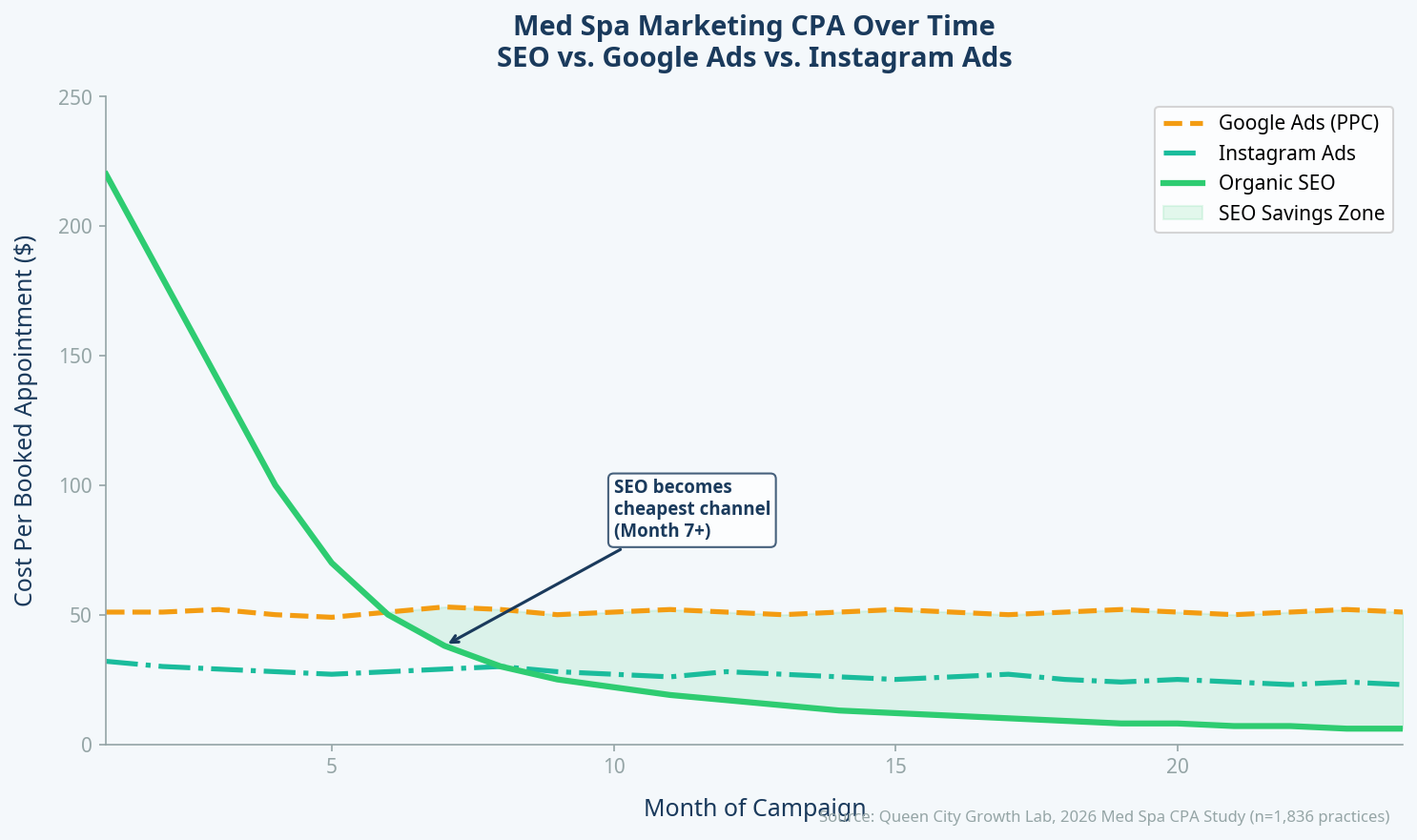
Unlike paid advertising, where visibility ceases the moment the budget runs out, SEO is a compounding asset. In the first few months, the effective CPA for SEO might appear high as the foundational work is laid. Yet, by month 12, the CPA typically drops significantly. Data indicates that a mature SEO strategy can drive the cost per booked appointment down to $8 to $25 [2].
Furthermore, organic visitors are self-selected. When a potential patient searches for "laser hair removal near me" and clicks on an organic result, they have actively bypassed ads to find a trusted provider. This trust translates directly into higher conversion rates. Self-selected organic visitors convert at 4% to 7%, compared to just 2% to 5% for paid traffic [2].
Ready to lower your patient acquisition costs? Claim your Free SEO Audit from SEOfly today and discover how we can help your med spa dominate local search.
What Are the Best SEO Keywords for Medical Spas?
Direct Answer: The best SEO keywords for medical spas combine specific treatments with local geographic modifiers, such as "Botox injections in [City]" or "laser skin resurfacing near me," because these transactional queries capture patients who are at the bottom of the funnel and ready to book a consultation.
Keyword research for med spas must move beyond generic terms. While ranking for "med spa [City]" is valuable, the real ROI lies in procedure-specific, long-tail keywords.
Transactional vs. Informational Intent
Understanding search intent is the cornerstone of an effective med spa SEO strategy.
Informational intent searches—such as "how long does Botox last?" or "what is a HydraFacial?"—represent patients in the research phase. Creating high-quality blog content around these FAQs drives top-of-funnel traffic. In fact, treatment FAQs drive 35% of organic traffic to med spa websites [1]. Transactional intent searches, by contrast—such as "Botox specials [City]" or "book lip filler appointment"—indicate a readiness to purchase. These keywords should be the primary focus of your service and location pages.
Keyword Strategy Framework
| Keyword Category | Example Query | Target Page Type | Conversion Intent |
|---|---|---|---|
| Broad Local | "Med spa Austin TX" | Homepage / About | Medium |
| Treatment Specific | "CoolSculpting cost in Miami" | Service Page | High |
| Problem/Solution | "Best treatment for acne scars" | Blog Post / FAQ | Low to Medium |
| Brand / Navigational | "[Your Med Spa Name] reviews" | Reviews / Testimonials | Very High |
By mapping your brand entities to these specific retrieval patterns, you ensure that both traditional search engines and emerging AI agents can easily synthesize your offerings and recommend your practice to local searchers. This approach is consistent with the strategies we outline in our broader plastic surgeon marketing guide.
How Can Med Spas Optimize Their Google Business Profile?
Direct Answer: Med spas can optimize their Google Business Profile (GBP) by ensuring consistent NAP (Name, Address, Phone) data, regularly uploading high-quality before-and-after photos, generating a steady stream of 5-star reviews, and utilizing the Q&A and Posts features to highlight specific treatments and promotions.
For local businesses like med spas, the Google Business Profile is arguably more important than the website itself. It is the digital storefront that appears in the "Local Pack"—the highly coveted top section of Google search results.
The Anatomy of a High-Converting GBP
Local SEO drives 78% of walk-in traffic for med spas [1]. To capture this traffic, your GBP must be flawlessly optimized. Accurate categorization is the first step: ensure your primary category is "Medical Spa," but also include relevant secondary categories like "Skin Care Clinic" or "Laser Hair Removal Service."
Aesthetics is a visual industry, so uploading professional photos of your clinic, staff, and verifiable before-and-after results builds immediate trust. Profiles with photos receive significantly more requests for directions and clicks to their websites. Review velocity is equally critical: 70% of clients check Google reviews before choosing a med spa [1], and a one-star increase in a Google rating can boost revenue by 5% to 9% [1]. Equally important is NAP consistency—your Name, Address, and Phone number must be identical across your GBP, website, and all local directories (Yelp, Healthgrades, etc.). Consistent NAP improves local SEO by 30% [1].
How Does Answer Engine Optimization (AEO) Affect Med Spas?
Direct Answer: Answer Engine Optimization (AEO) affects med spas by requiring them to structure their content—using Schema markup, clear FAQs, and direct answers—so that AI-driven search tools like Google's AI Overviews and ChatGPT can easily extract and cite their practice as the definitive local authority for aesthetic treatments.
As search engines evolve into answer engines, the way consumers find med spas is changing. While consumers still prefer to handle the final purchase themselves, nearly half use AI to validate choices or start their research.
Structuring Content for AI Agents
To succeed in 2026, med spas must optimize for the discovery phase. This involves three core pillars. First, Schema Markup: implementing MedicalClinic, FAQPage, and Review schema on your website. This structured data translates your site's content into a language that AI agents natively understand. Second, Direct Answers: formatting content with clear, concise answers immediately following an H2 heading (as demonstrated in this article). This increases the likelihood of being featured in AI Overviews. Third, Information Gain: AI models prioritize unique data. Including original case studies, specific pricing ranges, and proprietary patient satisfaction metrics provides the "information gain" necessary to outrank generic competitors.
Mid-Post Value Offer: Want to see how your med spa stacks up against local competitors in AI search? Contact SEOfly for a comprehensive AEO audit that identifies exactly where your practice is being cited—and where it isn't.
What Is the True Cost of Med Spa Marketing in 2026?
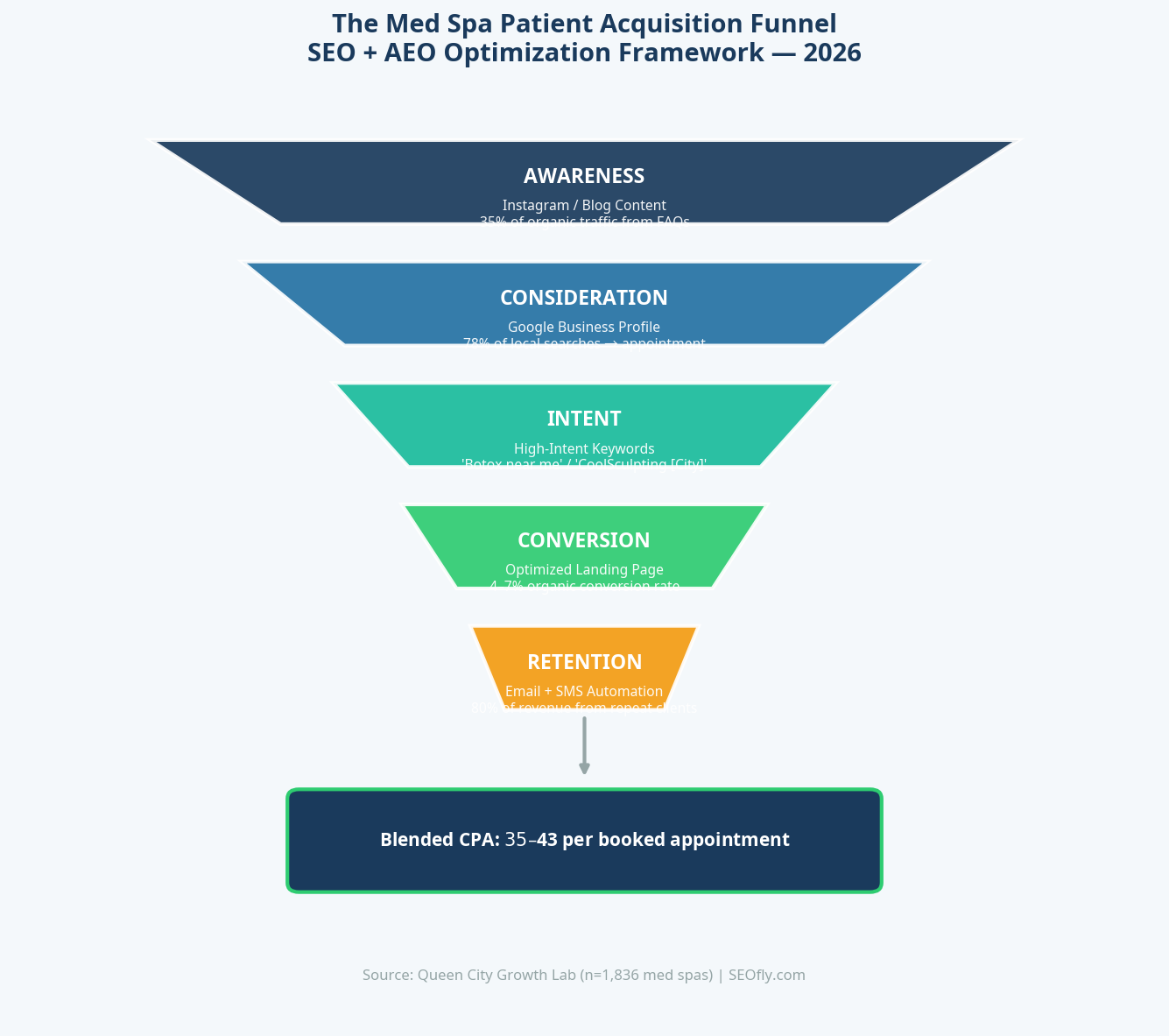
Direct Answer: The true cost of med spa marketing in 2026 is best measured by the Blended Cost Per Acquisition (CPA), which typically ranges from $35 to $60 per booked appointment when combining Google Ads ($25–$75 CPA), Instagram Ads ($15–$40 CPA), and mature SEO ($8–$25 CPA) into a unified, multi-channel strategy.
A common mistake med spa owners make is viewing marketing channels in isolation. They ask, "Should I do SEO or Google Ads?" This is a flawed premise. The most successful practices utilize a blended stack.
The Blended Marketing Stack
Different channels serve different stages of the patient journey. Instagram (Awareness & Desire) plants the seed: a patient sees a before-and-after Reel for lip fillers and becomes interested. Cost per click is low ($1.50–$5.00), but the decision cycle is long [2]. Google Ads (Intent Capture) converts that interest: a week later, the same patient searches "lip filler near me," your ad appears, and they book. The cost per click is higher ($8–$28), but the intent is immediate [2]. SEO (Trust & Authority) seals the deal: the patient searches your brand name to read reviews and verify your expertise, and your optimized site and GBP confirm your authority.
When these channels work together, they create efficiencies. For example, retargeting an organic website visitor with an Instagram ad is significantly cheaper than acquiring a cold lead. A well-run three-channel stack typically achieves a blended CPA that is 20% to 30% lower than any single channel's standalone CPA [2]. Notably, 54.7% of med spas do not include their city in their title tag, meaning they are overpaying on every paid click due to poor Quality Scores—a problem that a solid SEO foundation directly solves [2].
How Can Med Spas Improve Patient Retention Through Digital Marketing?
Direct Answer: Med spas can improve patient retention by utilizing targeted email marketing, SMS appointment reminders, and automated post-treatment follow-ups, which collectively can reduce client churn by up to 25% and drive a 35% increase in repeat visits.
Acquiring a new patient is expensive; retaining one is highly profitable. Repeat clients account for 80% of med spa revenue [1]. Therefore, your digital marketing strategy must extend beyond the initial booking.
The Power of Email and SMS
Email marketing remains incredibly lucrative in the aesthetic space, delivering a 38:1 ROI [1]. Automated email sequences can boost appointment bookings by 30% [1]. A well-timed email reminding a patient that they are due for their next Botox treatment can trigger an immediate booking. On the SMS side, 50% of clients prefer appointment reminders via text, and reminder messages reduce appointment no-shows by 25% [1]. Sending automated follow-up messages checking on a patient's recovery not only provides excellent customer service but drives a 35% increase in repeat visits [1].
By integrating your SEO efforts with a robust CRM and email marketing strategy, you create a closed-loop system that maximizes the lifetime value (LTV) of every patient acquired through organic search. This holistic approach to digital marketing mirrors the strategies that drive results across other high-value service industries, including financial advisors, personal injury attorneys, HVAC and roofing contractors, and home remodeling companies.
Conclusion
The med spa industry in 2026 is highly lucrative but intensely competitive. Relying solely on paid ads or word-of-mouth is no longer sufficient to sustain aggressive growth. By implementing a comprehensive SEO strategy—focusing on high-intent keywords, dominating the Google Business Profile, optimizing for Answer Engines, and understanding your true Cost Per Acquisition—your practice can secure a steady stream of high-value consultations.
For additional context on how procedure-specific SEO drives consultations, see our guides on breast augmentation SEO and rhinoplasty SEO. Stop letting your competitors capture the organic traffic in your city. It is time to build a digital presence that reflects the quality of your clinical outcomes.
Limited slots available for July 2026. SEOfly is currently accepting new med spa and plastic surgery clients. Contact us today to claim your free SEO audit before your competitors do—spots fill quickly.
Frequently Asked Questions (FAQ)
Q: How long does it take for med spa SEO to show results? A: While foundational improvements can yield minor traffic increases within 30 to 60 days, a comprehensive SEO strategy typically takes 4 to 6 months to generate a significant increase in booked appointments. The CPA continues to decrease as the campaign matures past month 12.
Q: Should my med spa focus on SEO or Google Ads? A: Both. Google Ads provides immediate visibility for high-intent searches, while SEO builds long-term, compounding authority. A blended approach lowers your overall Cost Per Acquisition and ensures you capture patients at every stage of their journey.
Q: What is the most important factor for local med spa SEO? A: Your Google Business Profile (GBP). Ensuring accurate categories, consistent NAP data across the web, regular photo uploads, and a high volume of positive reviews are the most critical elements for ranking in the Local Pack.
Q: How does Answer Engine Optimization (AEO) differ from traditional SEO? A: Traditional SEO focuses on ranking web pages on search engine result pages (SERPs). AEO focuses on structuring content (via Schema, direct answers, and FAQs) so that AI agents (like ChatGPT or Google's AI Overviews) can easily extract facts and cite your practice directly in their conversational responses.
Q: What is a good conversion rate for a med spa website? A: A strong conversion rate for organic med spa traffic is between 4% and 7%. Paid traffic typically converts at a slightly lower rate of 2% to 5% [2].
Q: How much should a med spa budget for SEO? A: A typical starting budget of $1,000 to $2,000 per month for SEO, combined with $1,500 for Google Ads and $500 to $800 for Instagram, creates an effective blended stack. By month 8, the SEO component typically delivers the lowest CPA of any channel in the mix [2].
References
[1] Abuzar Gaur. "Med Spa Marketing Trends: Key Statistics and Insights for 2025." LinkedIn Pulse, April 19, 2025. https://www.linkedin.com/pulse/med-spa-marketing-trends-key-statistics-insights-2025-abuzar-gaur-mnqdc
[2] Queen City Growth Lab. "Cost Per Booked Appointment: The Real Numbers in 2026." March 2, 2026. https://www.queencitygrowthlab.com/blog/cost-per-booked-appointment-2026
[3] First Page Sage. "Average Patient Acquisition Cost: 2026 Report." July 31, 2024. https://firstpagesage.com/seo-blog/average-patient-acquisition-cost/