Meta Title: Residential Roofing SEO 2026: Win High-Intent Leads & Claims (60 chars) Meta Description: Discover how residential roofing contractors can dominate local SEO in 2026. Learn proven strategies for high-intent keywords, insurance claim leads, and CRO. (158 chars)
When a homeowner notices a water stain on their ceiling or finds shingles in their yard after a severe storm, they do not open a phone book. They immediately pull out their smartphone and search Google for an emergency roofer. In 2026, the roofing industry is more digitally competitive than ever. Traditional marketing methods like door-knocking and buying shared leads from third-party platforms are yielding diminishing returns, while the cost of those shared leads continues to skyrocket.
For residential roofing contractors, Search Engine Optimization (SEO) is no longer just about having a website; it is about building a predictable, exclusive lead generation engine. A robust roofing SEO strategy captures homeowners at their highest point of urgency—whether they need an immediate patch, a full roof replacement, or an insurance claim inspection. This comprehensive guide will walk you through the exact strategies roofing companies are using in 2026 to rank number one in local search, target high-intent keywords, optimize for Answer Engine Optimization (AEO), and turn website traffic into booked jobs.
Why is Local SEO the Best Lead Generation Strategy for Roofers?
Direct Answer: Local SEO is the best lead generation strategy for roofers because it produces exclusive, high-intent inbound leads at the exact moment a homeowner needs service, resulting in higher conversion rates and a better long-term ROI compared to buying shared leads.
The fundamental flaw with buying leads from third-party platforms is that those same leads are often sold to four or five other contractors simultaneously [1]. This forces you into a race to the bottom on price and a frantic scramble to be the first to call. In contrast, organic SEO generates exclusive inbound leads. When a homeowner finds your roofing company at the top of Google Maps or organic search results, that lead belongs solely to you.
Furthermore, roofing is a high-ticket service driven by urgency and trust. A homeowner facing a $15,000 roof replacement wants to hire a local, reputable company. Local SEO builds that trust before you even answer the phone. When your Google Business Profile (GBP) appears in the Map Pack with a 4.8-star rating, alongside a fast, professional website, the homeowner is already pre-sold on your credibility [2].
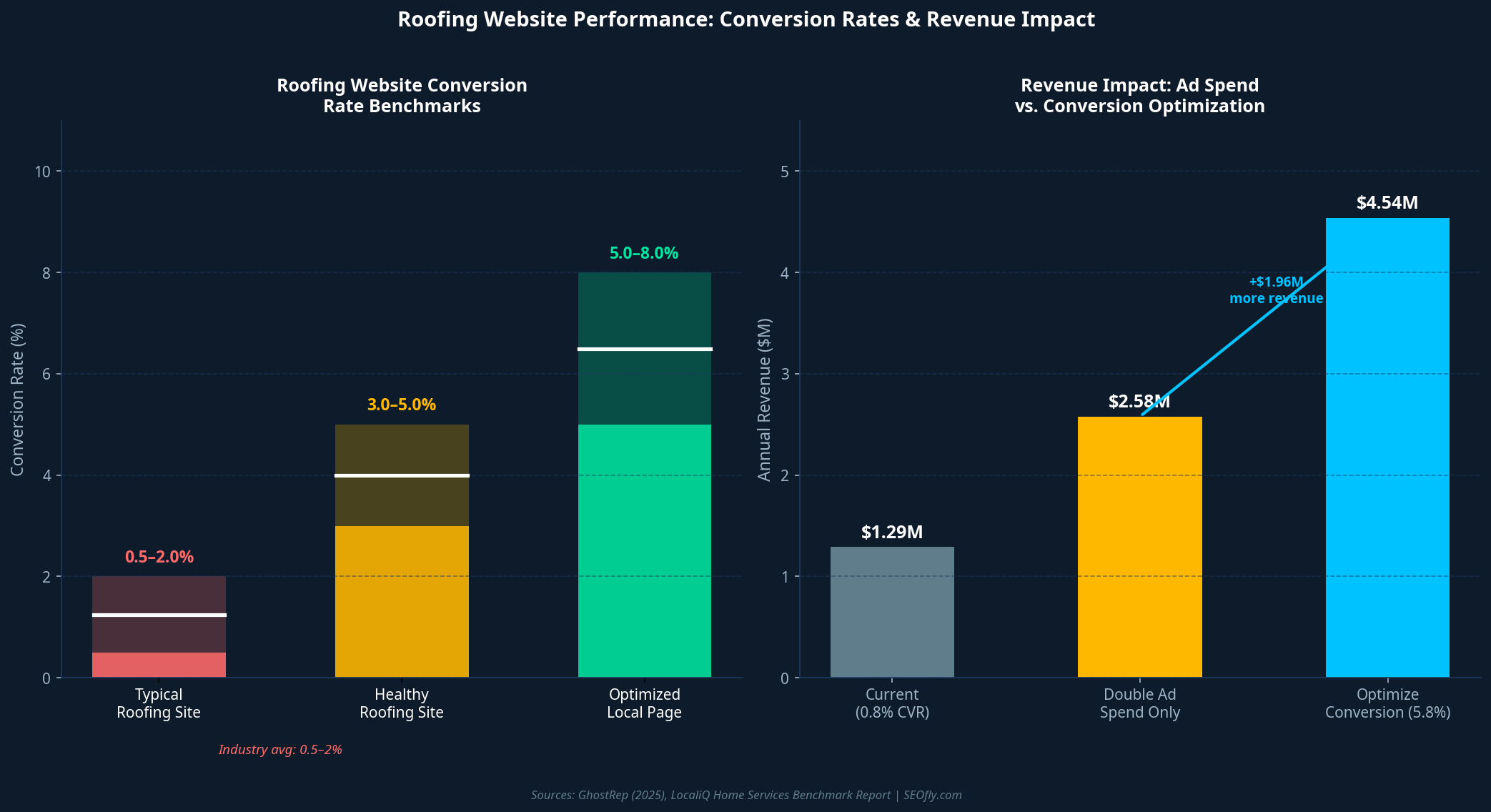
Data shows that while the average roofing website converts visitors at around 0.5% to 2%, highly optimized local roofing pages can reach conversion rates of 5% to 8% or higher [3]. By focusing on local SEO, you are not just buying traffic; you are building digital equity and a sustainable pipeline of high-value jobs that compounds over time.
Free Resource: Is your roofing website converting traffic into leads? Get a free, comprehensive SEO and CRO audit from SEOfly today and discover how to dominate your local market. Claim your free SEO audit here.
How Do You Target High-Intent Roofing SEO Keywords?
Direct Answer: To target high-intent roofing SEO keywords, contractors must focus on transactional phrases (e.g., "emergency roof repair near me" or "roof replacement [city]") rather than broad, informational terms, and create dedicated service and location pages for each specific keyword cluster.
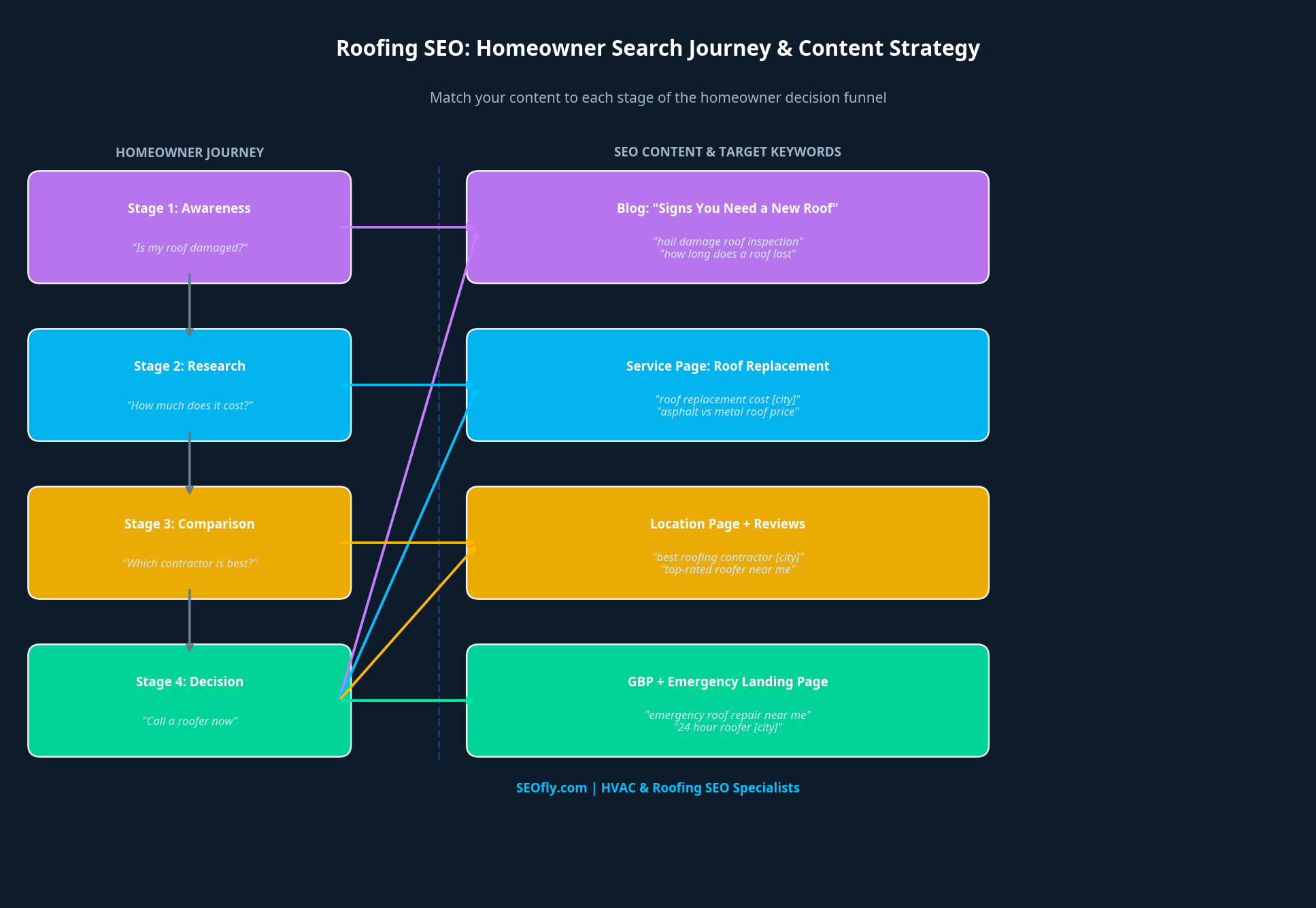
Not all website traffic is created equal. A homeowner searching for "how to patch a roof leak" is likely looking for a DIY tutorial and has very low commercial intent. Conversely, a homeowner searching for "24 hour emergency roof repair [city]" is holding a credit card and needs immediate professional help. The secret to a profitable roofing SEO campaign is targeting these high-intent, bottom-of-the-funnel keywords.
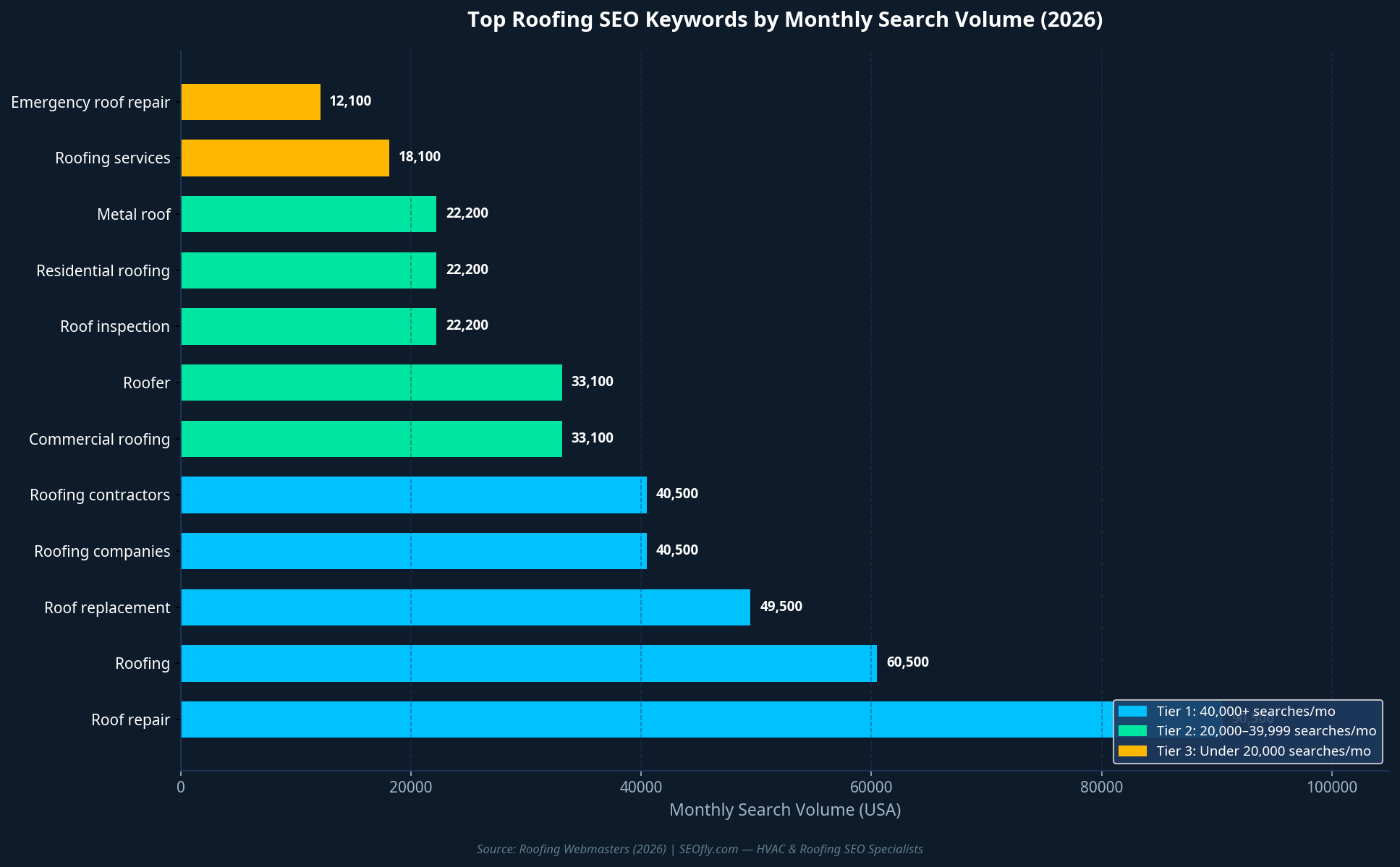
Keyword research data reveals that terms like "roof repair" (90,500 monthly searches) and "roof replacement" (49,500 monthly searches) are the primary drivers of industry traffic [4]. However, to win in local search, these broad terms must be localized. Your strategy should revolve around a two-layer keyword structure: evergreen keywords for core revenue and storm-based keywords for urgent leads [2].
| Keyword Type | Search Intent | Example Keywords | SEO Strategy |
|---|---|---|---|
| Evergreen / Core | High (Ready to hire for planned work) | "roof replacement [city]", "residential roofing contractor" | Optimize main service pages and homepage; focus on long-term local rankings. |
| Emergency / Storm | Very High (Needs immediate fix) | "emergency roof repair", "hail damage roof inspection" | Create dedicated landing pages for storm response and 24/7 emergency services. |
| Informational | Low to Medium (Research phase) | "cost of asphalt shingles vs metal", "how long does a roof last" | Write detailed blog posts to capture top-of-funnel traffic and build topical authority. |
To capture this traffic, you must build dedicated service pages. Do not list all your services on a single page. Instead, create separate, highly optimized pages for "Roof Replacement," "Roof Leak Repair," "Metal Roofing," and "Storm Damage Restoration." This allows Google to understand exactly what each page is about and rank it accordingly.
How Can Roofers Generate Insurance Claim Leads Through SEO?
Direct Answer: Roofers can generate insurance claim leads through SEO by creating dedicated, authoritative content that explains the local storm damage insurance claim process, how to document hail or wind damage, and offering free, no-obligation claim inspections.
Insurance claim jobs are the lifeblood of many residential roofing companies, especially in hail and hurricane-prone regions. However, homeowners are often intimidated and confused by the insurance process. They turn to Google for answers, and the roofing company that provides the clearest guidance usually wins the job.
To attract these leads, your website must feature dedicated content covering the insurance claim process. Create pages optimized for long-tail keywords like "how to file a roof insurance claim in [city]" or "hail damage roof inspector near me." Your content should educate the homeowner on how to document damage, what to expect when the insurance adjuster arrives, and how your company assists them throughout the entire process [5].
Answer Engine Optimization (AEO) plays a massive role here. AI search engines and Google's AI Overviews frequently pull from structured, authoritative content to answer complex questions. By formatting your insurance claim pages with clear H2 and H3 headings, bulleted lists of steps, and an extensive FAQ section, you increase the likelihood of being cited as the primary source when a homeowner asks an AI assistant about roof damage claims.
Mid-Post Value Offer: Download our free 2026 Roofing SEO Keyword & Conversion Checklist to ensure your website is fully optimized for local search and AI Overviews. Download the Checklist Now.
What is the Secret to Dominating the Google Map Pack for Roofers?
Direct Answer: The secret to dominating the Google Map Pack for roofers is a combination of a fully optimized Google Business Profile (with "Roofing Contractor" as the primary category), consistent NAP citations across the web, and a high velocity of recent, positive customer reviews.
The Google Map Pack—the three local business listings that appear at the top of local search results—is where the majority of emergency roofing calls originate. Proximity, relevance, and prominence are the three pillars Google uses to determine Map Pack rankings [2].
First, your Google Business Profile (GBP) must be flawlessly optimized. Ensure your primary category is set strictly to "Roofing Contractor." Add every specific service you provide, clearly define your service areas (including all relevant zip codes), and upload high-quality photos of your crew, trucks, and completed roofs on a weekly basis [2].
Second, local citations are critical. Your business Name, Address, and Phone number (NAP) must be 100% consistent across directories like Yelp, Angi, the Better Business Bureau, and local chambers of commerce. Inconsistent data confuses Google and severely damages your local rankings.
Finally, review velocity is the ultimate differentiator. It is not just about having a 5-star average; it is about how many reviews you get and how recent they are. A roofing company with 150 reviews from the last six months will almost always outrank a competitor with 300 reviews from three years ago. Implement an automated SMS review request system to ask for feedback the moment a job is completed, and train your sales reps to encourage homeowners to mention specific services (e.g., "Great roof replacement in Tampa") in their reviews.
How Does Website Conversion Rate Optimization (CRO) Impact Roofing Leads?
Direct Answer: Website Conversion Rate Optimization (CRO) impacts roofing leads by maximizing the percentage of visitors who contact you. By improving mobile page speed, displaying prominent trust signals, and offering low-friction conversion paths, roofers can drastically increase leads without spending more on traffic.
Driving traffic to your roofing website through SEO is only half the battle; converting that traffic into booked inspections is where the actual revenue is generated. The industry average conversion rate for a roofing website is a dismal 0.5% to 2% [3]. This means that out of 100 visitors, 98 or 99 leave without ever contacting you.
The primary reason roofing sites fail to convert is friction, particularly on mobile devices where over 60% of roofing searches occur [3]. A homeowner standing in their living room looking at a leaking ceiling will not tolerate a site that takes five seconds to load or requires them to pinch and zoom to find a phone number.
To implement effective CRO, start with mobile optimization. Ensure your phone number is a large, sticky "Click-to-Call" button that remains visible as the user scrolls. Second, utilize progressive disclosure on your contact forms. Instead of demanding a homeowner's name, email, phone, address, and project details upfront, start with two simple, low-friction questions: "What type of roofing service do you need?" and "What is your zip code?" [3].
Finally, surround your calls-to-action (CTAs) with trust signals. Place your GAF Master Elite badge, your BBB A+ rating, and real customer testimonials directly next to your "Schedule Free Inspection" button. When a homeowner feels safe, they convert.
Conclusion: Building a Sustainable Roofing Lead Engine
In 2026, relying on outdated marketing tactics or buying shared leads is a surefire way to stagnate your roofing business. The contractors who are dominating their local markets and securing the highest-ticket roof replacements are those who treat their online presence as a dedicated lead generation engine.
By focusing on local SEO, targeting high-intent and insurance-related keywords, aggressively managing your Google Business Profile, and optimizing your website for maximum conversions, you can build a sustainable, exclusive pipeline of high-value jobs. SEO is not an overnight fix, but it is the most powerful long-term investment you can make in your roofing company's growth.
Ready to stop sharing leads and start dominating your local roofing market? Don't let your competitors steal the best jobs in your service area. As a leading HVAC & Roofing SEO agency, SEOfly provides data-driven, custom SEO strategies tailored specifically for home service contractors. Let us build your digital presence while you focus on building roofs.
Urgent Exit CTA: Google's local search algorithms are updating rapidly. Don't wait until your competitors push you off the Map Pack. Contact SEOfly today to secure your local market share before storm season hits. We also offer specialized SEO services for plastic surgeons, financial advisors, personal injury attorneys, and home remodeling contractors.
Frequently Asked Questions (FAQ)
Q: How long does it take for a roofing company to see results from SEO? A: SEO is a long-term strategy. While you may see initial improvements in local Map Pack visibility within 60 to 90 days, substantial organic traffic growth and consistent lead generation typically take 6 to 12 months of sustained effort [1].
Q: Should I stop running Google Ads while waiting for SEO to work? A: No. A hybrid approach is best. Google Ads and Local Services Ads (LSAs) provide immediate visibility and lead flow, which is especially important during storm season, while your organic SEO builds long-term, sustainable authority and lowers your overall cost-per-lead over time [1].
Q: What is the most important ranking factor for roofing companies on Google Maps? A: A fully optimized Google Business Profile is the foundational factor, but the velocity and recency of positive customer reviews, combined with accurate NAP (Name, Address, Phone) citations across the web, are the primary drivers that push a roofer into the top three spots.
Q: Why is my roofing website getting traffic but no leads? A: High traffic with low conversions usually indicates a problem with your website's Conversion Rate Optimization (CRO). Common culprits include slow mobile load times, buried contact information, overly complex forms, or a lack of visible trust signals (like reviews and certifications) [3].
Q: How do I rank for "roof repair" in multiple cities? A: To rank in multiple cities, you must create dedicated, unique location pages for each city you serve. A single page stating "We serve all of County X" is rarely sufficient. Each location page should feature localized content, specific city keywords, and relevant local reviews.
References
[1] 99 Calls. "SEO for Roofing Contractors: Why It Matters More Than Ever in 2026." https://blog.99calls.com/2026/06/26/seo-for-roofing-contractors/ [2] GoMarketing. "How Roofing Companies Rank #1 in Local Google Search in 2026." https://gomarketing.com/blog/how-roofing-companies-rank-1-in-local-google-search-in-2026/ [3] GhostRep. "Roofing Website Conversion Rate: Benchmarks & Fixes." https://www.ghostrep.ai/blog/roofing-website-conversion-rate [4] Roofing Webmasters. "50 Most Searched Keywords for Roofing Companies in 2026." https://www.roofingwebmasters.com/50-keywords/ [5] Eye To Ad Media. "More Roofing Leads From Local Search." https://eyetoad.com/roofing-seo-denver/