
The yacht brokerage industry is intensely competitive, and the digital landscape is shifting rapidly. With the global luxury yacht market valued at $10.76 billion in 2026 and projected to reach $14.61 billion by 2031 [1], the stakes have never been higher for brokers who want to grow their business. Relying solely on traditional networking, boat shows, and expensive third-party marketplaces is no longer enough. To capture high-net-worth individuals (HNWIs) actively searching for their next vessel, you need a robust, modern SEO strategy.
In 2026, search engine optimization (SEO) for yacht brokers goes far beyond simply placing keywords on a webpage. It requires a comprehensive approach that includes Answer Engine Optimization (AEO), technical excellence, authoritative content, and strategic local SEO. This guide breaks down exactly how yacht brokers can leverage SEO to bypass marketplace commissions, build brand authority, and generate high-quality leads directly from Google.
Why Do Yacht Brokers Need Specialized SEO in 2026?
Direct Answer: Yacht brokers need specialized SEO in 2026 because high-net-worth buyers increasingly use search engines and AI assistants to research luxury purchases, and ranking organically allows brokers to capture these high-intent leads directly — without paying 10–15% commissions to third-party marketplaces.
The traditional model of yacht sales is evolving. While platforms like YachtWorld have historically dominated search results, savvy brokers are realizing the power of building their own digital real estate. By investing in SEO, you own your traffic source — it cannot be taken away by a platform policy change or a fee increase.
Consider the economics: a typical brokerage fee is 10% of the sale price [2]. On a $5 million yacht, that is a $500,000 commission. If your website ranks #1 for "luxury motor yachts for sale in Miami" and generates just one additional sale per year, the return on your SEO investment is astronomical. Furthermore, SEO traffic is compounding. Unlike paid ads, which stop generating leads the moment you turn off the budget, well-optimized content continues to attract buyers for years.
In 2026, the rise of AI search and Answer Engine Optimization (AEO) adds another dimension. Buyers are asking complex questions like, "What are the maintenance costs for a 40-meter superyacht in the Mediterranean?" Brokers who provide clear, structured answers to these queries will be cited by AI assistants (like Google's Gemini AI Overviews), capturing buyers early in their research journey. The SEO services market itself is now valued at $83.9 billion globally [3], reflecting how central search optimization has become to every industry — including luxury marine.
Is your yacht brokerage website leaking potential buyers to competitors? Stop guessing and start growing. Get your free, comprehensive SEO audit from SEOfly today and discover exactly how to dominate your market.
How Do You Build a Winning Keyword Strategy for Yacht Sales?
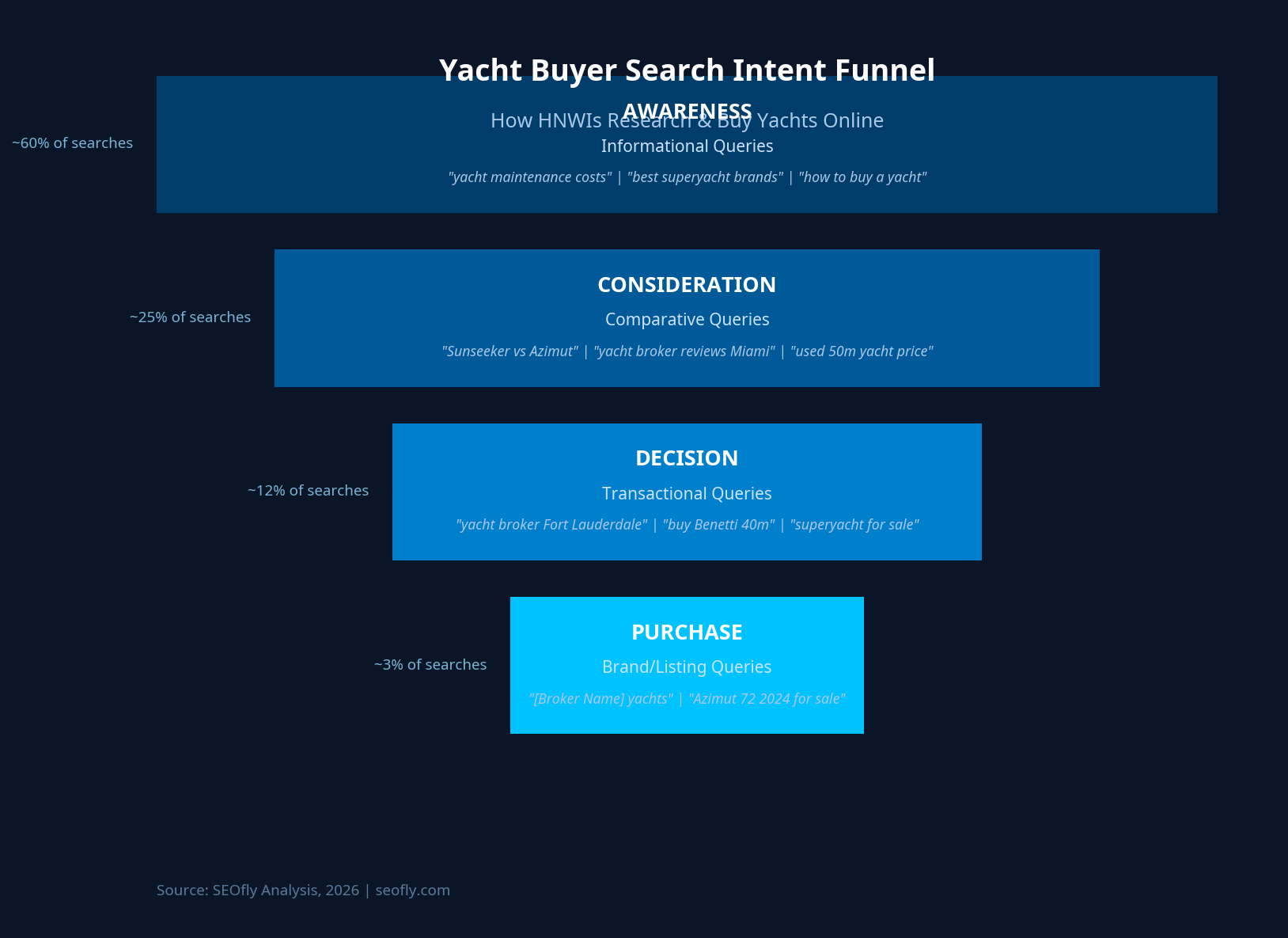
Direct Answer: A winning keyword strategy for yacht sales focuses on a mix of high-intent transactional queries (e.g., "superyacht broker Miami"), informational queries to capture early-stage buyers (e.g., "yacht maintenance costs"), and specific brand/model searches — prioritizing long-tail keywords with lower competition and higher conversion rates.
Keyword research is the foundation of any successful SEO campaign. In the yachting industry, you must target the specific language your buyers use. It is crucial to categorize your keywords by search intent and map them to the correct pages on your website.
Transactional Keywords (High Intent)
These are the "money" keywords. Searchers using these terms are ready to engage a broker or make a purchase. Examples include "yacht broker [City]", "luxury yachts for sale", and "buy a catamaran in [Region]". Optimize your homepage, location pages, and primary service pages for these terms.
Informational Keywords (Research Phase)
HNWIs conduct extensive research before buying. Capturing them at this stage builds trust and positions you as the authority. Examples include "how much does it cost to crew a 50m yacht", "best yacht brands for ocean crossing", and "yacht registration tax benefits". Create comprehensive blog posts and pillar pages (2,000+ words) answering these questions — this is also essential for AEO.
Navigational and Brand Keywords
Buyers often search for specific yacht builders or models. Examples include "Sunseeker 95 for sale", "Azimut yachts broker", and "Benetti Oasis 40M price". Ensure your individual yacht listing pages are meticulously optimized with the brand, model, and year in the title tags and H1 headers.
Data shows that 94.74% of all search queries get 10 or fewer monthly searches [4]. This highlights the critical importance of targeting long-tail keywords — highly specific phrases that may have lower search volume but significantly higher conversion rates and far less competition. For a yacht broker, ranking for "40-meter motor yacht for sale Fort Lauderdale" is far more valuable than fighting for the impossible-to-win "yacht for sale."
What Are the Core Technical SEO Requirements for Yacht Brokerages?
Direct Answer: Core technical SEO requirements for yacht brokerages include lightning-fast page load speeds (under 3 seconds), flawless mobile responsiveness, secure HTTPS encryption, optimized site architecture with clean URL structures, and the implementation of schema markup for individual yacht listings.
Technical SEO ensures that search engines can crawl, index, and understand your website without encountering errors. For luxury brands, technical excellence is also a matter of user experience (UX). A slow, clunky website instantly damages the perception of your brand before a prospect has even seen a single listing.
Here are the critical technical elements to prioritize in 2026:
Mobile Optimization: Over 60% of web traffic is mobile [5]. Your site must not just "work" on a smartphone; it must offer a premium, seamless experience. High-resolution images and videos must load quickly without layout shifts (Cumulative Layout Shift is a Core Web Vital measured by Google).
Site Speed: Google uses page speed as a direct ranking factor. Compress your high-quality yacht photos, utilize a Content Delivery Network (CDN), and minimize heavy JavaScript. Your target is a page load time under 3 seconds on mobile.
Site Architecture: Your website should have a logical hierarchy. A user should be able to navigate from the homepage to a specific yacht listing in three clicks or fewer. A clean architecture also helps search engine crawlers discover and index all of your listings efficiently.
Schema Markup: This is vital for yacht brokers. Implementing Product or Offer schema on your listings helps search engines understand specific details (price, brand, length, year) and can result in rich snippets in search results, dramatically improving click-through rates.
Want to see how your technical SEO stacks up against the top brokerages? We specialize in SEO for high-ticket service businesses. Explore our home remodeling SEO services and real estate SEO services to see how we drive results for premium brands — and apply the same rigor to your brokerage.
How Does Content Marketing Drive Yacht Sales?
Direct Answer: Content marketing drives yacht sales by establishing the brokerage as an industry authority, answering complex buyer questions to capture early-stage search traffic, and providing rich, optimized content (like market reports and buying guides) that earns valuable backlinks and satisfies AI search algorithms.
In the luxury sector, trust is paramount. Content marketing is how you build that trust at scale. A website that only lists boats for sale is just a catalog; a website with comprehensive guides, market analysis, and expert advice is a destination — and a destination earns loyalty and repeat visits.
The Pillar and Cluster Strategy
To dominate search results, adopt a "pillar and cluster" content architecture. Create a massive, definitive pillar page on a broad topic (e.g., "The Ultimate Guide to Buying a Superyacht"). Then write supporting cluster articles on specific subtopics (e.g., "Superyacht Financing Options", "Choosing the Right Flag State", "Superyacht Crew Salaries 2026"). Link all cluster articles back to the main pillar page, and link the pillar page out to the clusters. This signals topical authority to Google and dramatically improves rankings for the entire content cluster.
Visual Content and AEO Optimization
In 2026, visual search is a major ranking factor. Google's Vision AI analyzes images to understand context — a broker who uploads a high-resolution photo of a specific yacht model is more likely to rank for that model's name even without the keyword in the text. You must use original, high-resolution photography and video. Furthermore, to optimize for Answer Engine Optimization (AEO), structure your content with clear, question-based H2 headings followed immediately by concise answers. AI assistants prefer to pull answers from clearly structured text, making this format essential for appearing in AI Overviews.
Why is Local SEO Crucial for Marine Businesses?
Direct Answer: Local SEO is crucial for marine businesses because yacht buyers often search for brokers, marinas, and services within specific geographic locations, and optimizing a Google Business Profile ensures visibility in the highly coveted "Local Pack" map results that appear above organic listings.
Even though yacht sales are global, the relationship between broker and buyer often starts locally. A buyer in Florida will likely search for a "yacht broker in Fort Lauderdale" before expanding their search. Appearing in the Local Pack for these searches is enormously valuable.
Google Business Profile (GBP) Optimization in 2026
Your Google Business Profile is your digital storefront on Google Maps. In 2026, GBP optimization requires active, ongoing management rather than a one-time setup. Businesses with complete profiles experience significantly higher engagement and lead generation — one 2025 report found that 48% of local-intent searches led to a GBP interaction within 24 hours, and businesses that include photos saw 45% more direction requests and 31% more website clicks [6].
Key GBP optimization tactics for yacht brokers include ensuring your NAP (Name, Address, Phone number) is perfectly consistent across the web; selecting the most accurate primary category (e.g., "Yacht Broker") and relevant secondary categories; uploading high-quality exterior and interior photos of your office, team, and the yachts you represent; and implementing a systematic process to consistently request reviews from happy clients. Google now uses review volume, sentiment, and response speed as trust indicators in its local ranking algorithm.
The same local SEO principles that drive results for HVAC and roofing contractors and personal injury attorneys apply directly to yacht brokers — geographic relevance, consistent citations, and active profile management are universal pillars of local search dominance.
Comparing Yacht SEO to Traditional Marketing Channels
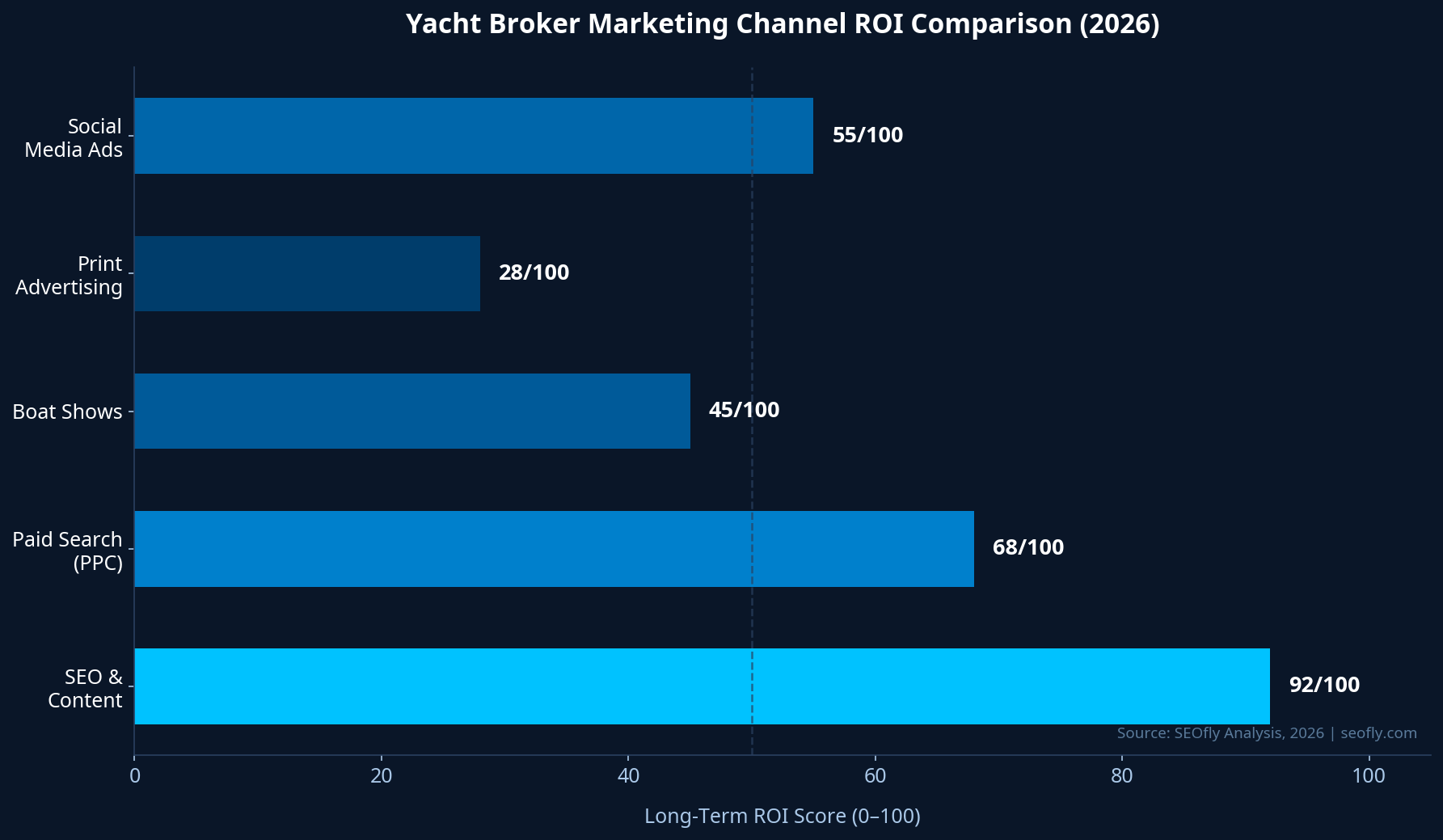
How does SEO stack up against traditional yacht marketing methods like boat shows or print advertising? The comparison reveals a clear winner for long-term, sustainable growth.
| Marketing Channel | Cost Structure | Targeting Precision | Longevity of Results | ROI Potential |
|---|---|---|---|---|
| SEO & Content Marketing | High initial investment, low ongoing cost | Extremely high (intent-based) | Years (Compounding) | Very High |
| Paid Search (PPC) | Pay per click (continuous spend) | High (keyword-based) | Zero (stops when budget stops) | Moderate to High |
| Boat Shows | Very high (booth, travel, logistics) | Moderate (broad audience) | Days (event duration) | Moderate |
| Print Advertising | High recurring costs | Low (demographic only) | Weeks (issue lifespan) | Low to Moderate |
| Social Media Ads | Continuous spend required | Moderate (interest-based) | Zero (stops when budget stops) | Low to Moderate |
As the table illustrates, while boat shows remain important for relationship-building and networking, SEO provides the most sustainable, long-term return on investment by capturing buyers exactly when they are searching for your services. The same compounding effect that makes SEO powerful for financial advisors and plastic surgeons applies with equal force to luxury marine brokerages.
What Does a Realistic SEO Growth Timeline Look Like for a Yacht Broker?
Direct Answer: A realistic SEO growth timeline for a yacht broker shows minimal results in the first 1–3 months (foundation phase), meaningful traffic and lead growth between months 4–6, and significant, compounding returns from month 7 onward — with the investment paying for itself many times over by the end of year one.
Setting realistic expectations is critical for any SEO campaign. The chart below illustrates a composite growth trajectory based on typical results for luxury service businesses investing in a comprehensive SEO strategy.
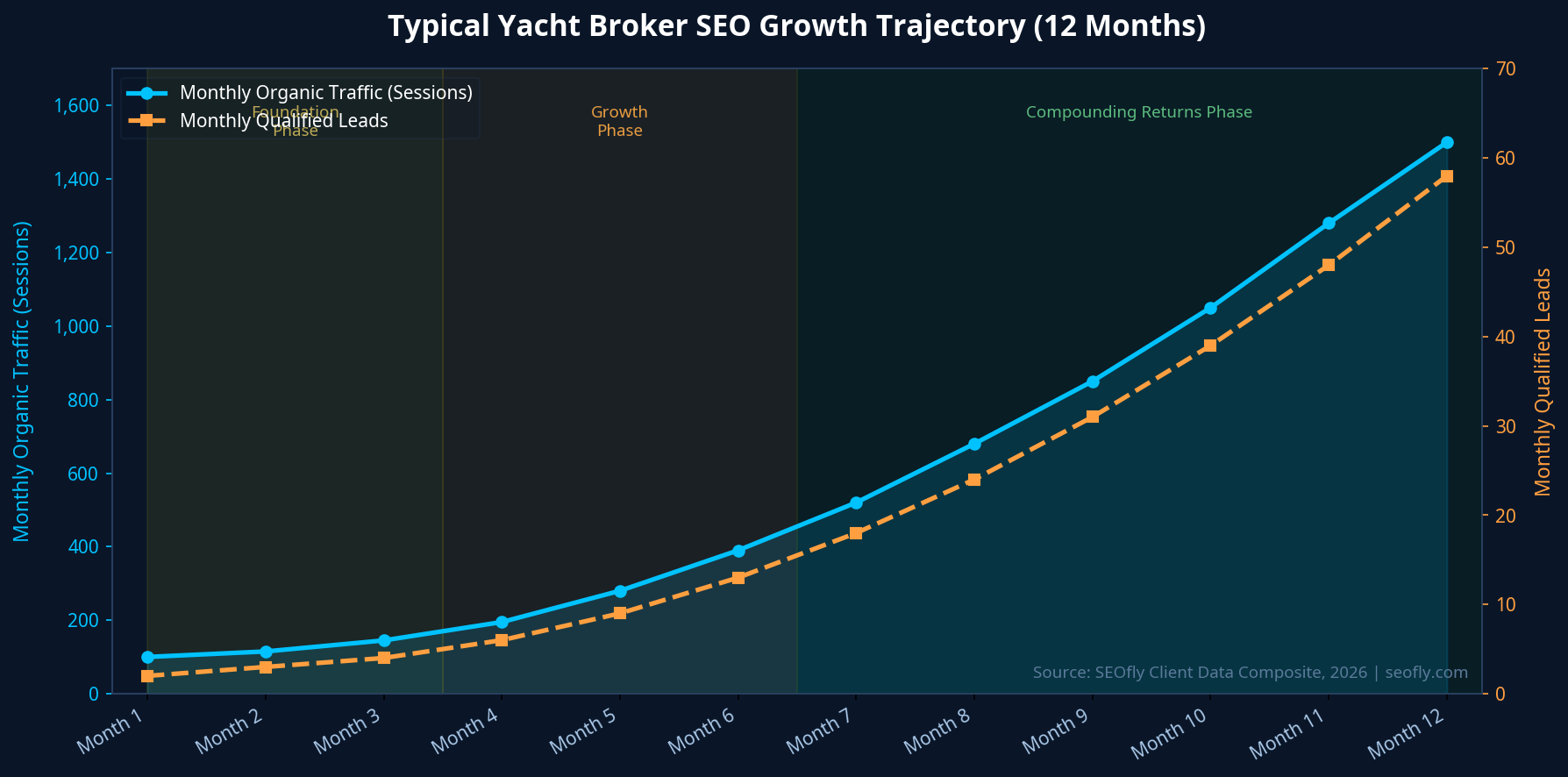
The three phases of SEO growth for yacht brokers are as follows. During the Foundation Phase (Months 1–3), the focus is on technical audits, fixing crawl errors, optimizing existing pages, and publishing the first pillar content. Ranking improvements are minimal but the groundwork is being laid. In the Growth Phase (Months 4–6), content begins to rank, organic traffic climbs, and the first qualified leads start arriving through organic search. By the Compounding Returns Phase (Months 7–12), the content cluster strategy kicks in, domain authority increases, and traffic and leads grow exponentially. This is where the true ROI of SEO becomes undeniable.
Frequently Asked Questions (FAQ)
Q: How long does it take to see results from yacht broker SEO? A: SEO is a long-term strategy. Generally, it takes 3 to 6 months to see noticeable improvements in rankings and traffic, and 6 to 12 months to see a significant impact on lead generation and sales, depending on the competitiveness of your market and the quality of your existing website.
Q: Should I focus on SEO or Google Ads (PPC) for my brokerage? A: Ideally, both in combination. Google Ads can provide immediate visibility and leads while your SEO strategy builds momentum. However, SEO provides a much higher long-term ROI and builds sustainable brand authority that PPC cannot match. Once SEO is established, it dramatically reduces your cost per lead.
Q: Does social media impact my SEO rankings? A: Social media does not directly impact your Google rankings. However, a strong social media presence can drive traffic to your website, increase brand awareness, and help your content earn backlinks — all of which indirectly support your SEO efforts and domain authority.
Q: What is AEO and why does it matter for yacht brokers? A: Answer Engine Optimization (AEO) is the practice of structuring your content so it can be easily read and cited by AI search assistants (like ChatGPT or Google's AI Overviews). It matters because HNWIs are increasingly using AI to research complex luxury purchases, and being cited by AI builds enormous trust and brand authority.
Q: How important are reviews for a yacht brokerage's local SEO? A: Reviews are critically important. Google uses review volume, recency, and sentiment as direct local ranking signals. A brokerage with 50 detailed, positive Google reviews will consistently outrank a competitor with 10 reviews, all else being equal. Develop a systematic post-transaction review request process.
Q: What type of content performs best for yacht broker SEO? A: Comprehensive, data-driven pillar content (2,000+ words) on topics like "how to buy a yacht," market reports, and specific model guides performs best for long-term rankings. Pair these with shorter, targeted listing pages and location-specific service pages for a complete content architecture.
Conclusion: Own Your Digital Waters
The yacht brokerage industry in 2026 demands a sophisticated digital presence. Relying on outdated marketing tactics or surrendering your leads to third-party marketplaces is a recipe for stagnation. By implementing a targeted SEO strategy — focusing on technical excellence, authoritative content, Answer Engine Optimization, and local visibility — you can position your brokerage directly in front of high-net-worth buyers at the exact moment they are ready to act.
Owning your digital real estate is the most valuable investment you can make in your firm's future. The brokerages that invest in SEO today will be the ones capturing the market's growth as the luxury yacht market expands toward $14.61 billion by 2031. It is time to stop chasing leads and start controlling demand.
Ready to dominate the digital seas? Don't let your competitors capture your market share. The team at SEOfly has built proven SEO systems for high-ticket service businesses across every major industry. Whether you need specialized SEO for your brokerage, or want to explore our expertise in financial advisor SEO, personal injury attorney SEO, or home remodeling SEO, we deliver results that drive revenue. Spots are limited — claim your free SEO audit today before your competitor does.
References
[1] Mordor Intelligence. "Luxury Yacht Market Size & Share Analysis." 2026. https://www.mordorintelligence.com/industry-reports/luxury-yacht-market
[2] Windward Yachts. "Yacht Brokerage Fees: What You Should Know." March 5, 2026. https://www.windwardyachts.com/blog/yacht-broker-fees-commissions/
[3] Instant Press. "SEO Statistics for 2026." June 10, 2026. https://www.instantpress.co/seo-statistics
[4] Ahrefs. "107 SEO Statistics for 2026." June 2, 2026. https://ahrefs.com/blog/seo-statistics/
[5] Asia Yacht Services. "Yacht SEO: How to Rank Your Brokerage on Google (2026 Guide)." April 7, 2026. https://services.asiayachtservices.com/resources/yacht-seo-guide
[6] Agency Jet. "Google Business Profile: The Updated Guide to the 2026 AI Evolution." January 19, 2026. https://www.agencyjet.com/blog/google-business-profile-optimization-guide/