
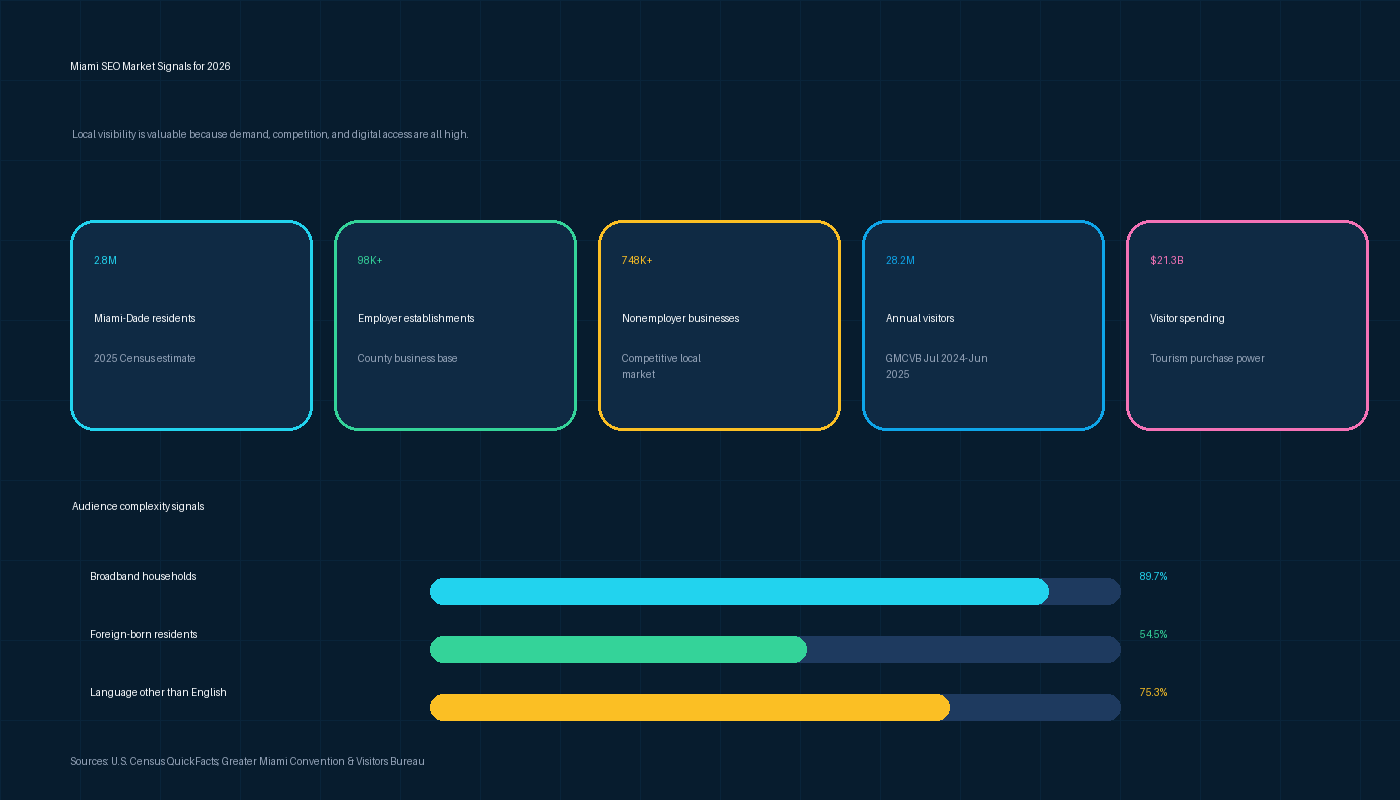
For businesses evaluating seo miami fl opportunities in 2026, the central question is not whether local search matters. It is whether your website, Google Business Profile, reviews, service pages, and conversion paths are strong enough to win in a market where customers compare options quickly. Miami-Dade County has an estimated 2.8 million residents, more than 98,000 employer establishments, and roughly 748,000 nonemployer businesses, which means local visibility is both valuable and crowded.1 This case-study guide explains how a Miami service business can turn local SEO, answer engine optimization, and conversion strategy into measurable lead growth.
Table of Contents
- What makes SEO Miami FL different in 2026?
- How did this Miami case study model define the opportunity?
- Which local ranking factors matter most for Miami service businesses?
- How should a Miami business structure neighborhood and service pages?
- How do reviews and AI recommendations change local SEO in Miami?
- What technical SEO fixes create the fastest local gains?
- What content plan turns Miami search demand into qualified leads?
- How should Miami SEO be measured against revenue?
- What 90-day action plan should a Miami business follow?
- FAQ: SEO Miami FL
- Conclusion: Win the Miami search market before competitors do
What makes SEO Miami FL different in 2026?
Direct answer: SEO in Miami is different because it combines dense competition, multilingual search behavior, neighborhood-level intent, tourism-driven demand, and AI-assisted discovery. A winning strategy must connect Google Maps, organic pages, reviews, bilingual content, answer-ready FAQs, and conversion tracking instead of treating SEO as isolated keyword ranking.
Miami is not a generic local market. The county’s 2025 population estimate is 2,802,029, and the 2020-2024 Census profile reports that 54.5% of residents are foreign-born and 75.3% speak a language other than English at home.1 That changes keyword research, page structure, review strategy, and sales copy. A law firm in Brickell, a med spa in Coral Gables, an HVAC company in Kendall, and a restaurant group in Wynwood may all need local SEO, but they do not compete in the same search context.
The market is also digitally reachable. Census QuickFacts reports that 96.7% of Miami-Dade households have a computer and 89.7% have a broadband internet subscription.1 In practical terms, your customers can compare local providers at the moment of need. They can also ask AI tools, scan review platforms, compare map results, and leave your site in seconds if your page does not answer the buying question.
Tourism makes the opportunity even more valuable. Greater Miami and Miami Beach reported 28.2 million visitors from July 2024 through June 2025, a 4.5% year-over-year increase, with $21.3 billion in total visitor spending.2 That demand affects restaurants, hospitality, transportation, cosmetic services, medical providers, entertainment, luxury real estate, and home-service companies that serve property owners and short-term rental operators.
The strategic takeaway is simple: Miami local SEO must be hyperlocal, multilingual-aware, reputation-led, and conversion-focused. Ranking for a phrase is useful only when the page earns trust and turns searchers into calls, forms, bookings, or consultations.
How did this Miami case study model define the opportunity?
Direct answer: This case-study model starts with a realistic Miami service business baseline: limited local landing pages, inconsistent review velocity, thin Google Business Profile content, and no answer-first FAQ strategy. The opportunity is built by mapping demand across neighborhoods, services, languages, and conversion intent, then prioritizing fixes by revenue impact.
Because many SEO case studies hide the assumptions, this guide uses a transparent model rather than pretending one anonymous company represents the entire market. The model is a composite Miami service business with three core services, one primary location, five priority neighborhoods, a modest review base, and a website that ranks for brand terms but underperforms for non-brand local searches. This is the profile SEOfly often sees in competitive service categories: the business is legitimate, but its digital proof does not match its real-world value.
Miami-Dade was ranked the number-one U.S. county for small business applications in a 2025 county release, with nearly 4,900 new business applications per 100,000 residents filed the prior year.3 That entrepreneurial growth creates two pressures. First, more businesses are competing for the same local search visibility. Second, customers have more choices, which makes proof, speed, clarity, and reviews more important.
Inline CTA: Get a free Miami SEO audit. If you want to know where your business is losing visibility, request a free growth audit from SEOfly. The same team behind seo miami fl growth strategy can benchmark your map rankings, local pages, reviews, and conversion paths against real Miami competitors. SEOfly highlights that it is trusted by 100+ businesses nationwide and focuses on revenue-driven SEO and AEO.
The model’s opportunity map begins with five questions. Which neighborhoods produce profitable customers? Which services produce the best margins? Which searches show urgency? Which competitors have stronger reviews, photos, and pages? Which pages already receive impressions but fail to convert? A business that answers these questions can stop chasing vanity traffic and start building a local acquisition system.
Which local ranking factors matter most for Miami service businesses?
Direct answer: The most important Miami local ranking factors are proximity signals, Google Business Profile completeness, service-page relevance, review quality and recency, local citations, topical authority, schema markup, page speed, and conversion trust. The winners align all of these signals around specific services and neighborhoods instead of relying on a homepage alone.
The mistake many Miami businesses make is assuming that one homepage can rank for every service and every neighborhood. It rarely can. A homepage may support brand authority, but local intent usually needs specific proof. Someone searching for an emergency plumber near Coconut Grove, a cosmetic consultation in Miami Beach, or a financial advisor in Brickell wants evidence that the provider serves that exact need and geography.
| SEO component | Generic local SEO approach | Miami-specific approach | Why it matters in 2026 |
|---|---|---|---|
| Keyword targeting | Broad city terms only | City, neighborhood, service, and bilingual modifiers | Miami-Dade has large multilingual and foreign-born populations, so search language and local terms vary.1 |
| Google Business Profile | Basic NAP and hours | Services, photos, posts, Q&A, review responses, and category testing | Maps visibility influences high-intent calls and direction requests. |
| Landing pages | One service page | Service pages plus priority-neighborhood proof | Competitive markets need relevance depth, not thin location pages. |
| Reviews | Passive collection | Fresh reviews by service, location, and outcome | 97% of consumers read reviews for local businesses, according to BrightLocal.4 |
| Content | Blog posts for traffic | Answer-first pages built for AI Overviews, Google, and sales enablement | AI recommendations increasingly summarize trusted sources.4 |
| CRO | Contact form only | Calls, forms, proof blocks, FAQs, offers, and fast mobile paths | Ranking gains are wasted if visitors do not convert. |
The strongest strategy combines local SEO, answer engine optimization, and conversion rate optimization. Local SEO earns visibility in maps and organic results. AEO helps pages become concise, quotable answers for Google and AI assistants. CRO turns the visit into a measurable action. This is why a Miami campaign should not be judged only by keyword position. It should be judged by qualified calls, form submissions, booked consultations, revenue, and pipeline value.
For a broader view of modern AI-led search, read SEOfly’s post on why Florida businesses are switching to AI-powered SEO. For local-service parallels, the local SEO blueprint for window and door replacement companies shows how neighborhood proof and service intent work together.
How should a Miami business structure neighborhood and service pages?
Direct answer: A Miami business should build pages around high-value service intent first, then add neighborhood relevance where it is genuinely useful. Each page should include a direct answer, service proof, local context, reviews, FAQs, internal links, conversion offers, and schema-friendly details that help both search engines and AI tools understand the page.
The best architecture starts with a hub page and supporting spokes. The homepage can target the broad brand and authority story. Core service pages should target commercial intent such as “emergency HVAC repair,” “rhinoplasty consultation,” or “personal injury lawyer.” Priority neighborhood sections should then connect each service to real local proof, such as before-and-after examples, service radius notes, client types, landmarks, parking context, or local regulations.
Miami’s density makes this structure important. Census data shows 1,422.1 people per square mile in Miami-Dade in 2020.1 A searcher in Doral may not behave like a searcher in South Beach, even if both use the word “Miami.” For local SEO, proximity and relevance are not abstract concepts. They shape whether a user believes your business is close enough, experienced enough, and trustworthy enough to contact.
A strong page should open with the answer, not a generic brand paragraph. For example, a service page can state who the service is for, what problem it solves, where it is available, and what action the visitor should take. The page can then add proof: reviews, credentials, response times, project examples, pricing guidance when appropriate, and an FAQ section that anticipates objections.
Internal linking should reinforce the topical map. A Miami local SEO post should link to the homepage, the relevant hub, related industry pages, and existing blog posts. For instance, a professional services company can compare its strategy with SEO & AEO for Personal Injury Attorneys, because legal SEO shows how high-value leads depend on trust, review quality, and urgent-intent pages. The same logic applies to med spas, financial advisors, contractors, and healthcare providers.
How do reviews and AI recommendations change local SEO in Miami?
Direct answer: Reviews now affect both human trust and machine-mediated discovery. BrightLocal’s 2026 survey reports that 97% of consumers read reviews for local businesses, 41% always read them, and consumers use an average of six review sites. Miami businesses need review velocity, response quality, and review diversity, not just star count.4
Reviews are no longer a side task handled when someone remembers. They are an acquisition asset. BrightLocal reports that consumers increasingly use multiple sources, with Google, Facebook, and AI tools such as ChatGPT among the most common sources for local recommendations.4 That matters because AI systems often summarize entities from public signals. If your business has thin reviews, inconsistent descriptions, and weak third-party mentions, it may be less likely to appear in answer-style recommendations.
The review bar is also rising. BrightLocal’s 2026 survey notes that consumers expect higher star ratings and fresher reviews, with more customers only using businesses with 4.5+ stars.4 In Miami, where customers may be choosing between several nearby providers, a stale review profile can quietly reduce calls even if rankings hold steady. Fresh proof helps users believe the business is active, responsive, and safe to choose.

The correct process is systematic. Ask for reviews shortly after successful service delivery. Make the request specific to the service and location when appropriate. Respond quickly and personally. Look for recurring language in reviews, because customers often describe benefits in words that can inform page copy. If reviewers repeatedly mention “same-day appointment,” “Spanish-speaking staff,” “easy parking,” or “Brickell office,” those are conversion signals worth reflecting on relevant pages.
This is also where AEO connects to reputation. A page that answers “Who is the best provider near me?” must give the machine and the human a reason to trust it. Structured FAQs, consistent NAP data, descriptive testimonials, author or team credentials, and links from relevant pages all help build the evidence layer. SEOfly’s guide to the four signals that define AI search visibility expands on why rankings alone are no longer enough.
Mid-post value offer: If your review profile is strong but leads are inconsistent, SEOfly can identify whether the leak is in maps visibility, page relevance, AI answer readiness, or conversion design. Request a free growth audit and ask for a Miami competitor gap snapshot covering reviews, pages, citations, and calls-to-action.
What technical SEO fixes create the fastest local gains?
Direct answer: The fastest technical gains usually come from fixing indexation, duplicate location pages, inconsistent titles, missing schema, slow mobile templates, weak internal links, broken conversion tracking, and Google Business Profile mismatches. These fixes help search engines trust the site and help visitors reach a conversion path faster.
Technical SEO is not just for enterprise websites. Local businesses often lose visibility because their site architecture sends mixed signals. Common problems include multiple pages targeting the same phrase, old URLs still indexed after redesigns, missing canonical tags, thin city pages, service pages with identical copy, and contact pages that do not clearly connect to Google Business Profile data.
Miami businesses should pay special attention to mobile speed and clarity. With 89.7% of Miami-Dade households reporting broadband subscriptions, customers are comfortable researching online, but that does not mean they will tolerate a slow or confusing website.1 Mobile visitors need click-to-call buttons, clear forms, visible trust signals, and fast-loading pages. If a page takes too long to explain the offer, competitors are one tap away.
Schema markup is another practical fix. LocalBusiness, Organization, FAQPage, Service, Review, and Breadcrumb schema can help search systems understand the entity, page hierarchy, and answer structure. Schema does not guarantee rankings, but it reduces ambiguity. In an AI-search environment, clarity is a competitive advantage.
Tracking must be technical too. A campaign should separate calls from organic search, Google Business Profile, paid campaigns, referral traffic, and direct visits where possible. Without call tracking, form tagging, and CRM attribution, a business may underinvest in pages that are producing revenue or overvalue pages that only produce impressions.
What content plan turns Miami search demand into qualified leads?
Direct answer: A profitable Miami content plan targets buying intent before broad education. It should prioritize service pages, neighborhood proof pages, comparison content, pricing guidance, review-led FAQs, and answer-first blog posts that support sales conversations. The goal is not more content; it is more qualified customers from the right searches.
Content should begin with the commercial map. A service business can divide topics into urgent intent, planned purchase intent, comparison intent, and trust-building intent. Urgent intent might include “near me,” “open now,” “same day,” or “emergency.” Planned purchase intent might include procedure, consultation, installation, inspection, or audit keywords. Comparison intent includes “best,” “cost,” “agency,” “company,” “reviews,” and “versus.” Trust-building intent includes FAQs, credentials, case studies, checklists, and outcome explanations.
The answer-first structure matters because users and AI systems prefer concise, extractable answers. Each H2 in this article begins with a direct answer because that format helps a reader understand the point quickly. It also gives search systems a clearer passage to evaluate. This does not replace depth. It makes depth easier to access.
Data should appear often enough to support decisions. Miami-Dade’s economy includes $67.1 billion in 2022 retail sales, $30.3 billion in health care and social assistance revenue, and $15.4 billion in accommodation and food-service sales, according to Census QuickFacts.1 Those categories translate into real SEO competition because many local buyers research providers before calling, visiting, or booking.
A strong internal linking plan connects blog education to commercial pages. This article links to SEOfly for broad SEO and AEO services, to the homepage hub with the exact-match anchor seo miami fl, and to a lateral industry page for professional-service SEO. It also connects to existing SEOfly blog posts about AI-powered SEO and local service SEO so that readers and search engines can follow the topical cluster.
How should Miami SEO be measured against revenue?
Direct answer: Miami SEO should be measured by revenue indicators, not ranking screenshots alone. Track local map visibility, organic entrances, qualified calls, form submissions, booked consultations, lead quality, close rate, cost per acquired customer, and assisted revenue. Rankings matter, but only as one signal in a larger growth system.
The measurement system should connect SEO work to business outcomes. A business owner does not need another report full of vanity metrics. They need to know whether the campaign is producing more qualified demand, whether calls are relevant, whether the sales team is responding fast enough, and which pages influence closed revenue.
| Metric | Why it matters | Recommended reporting cadence |
|---|---|---|
| Google Business Profile calls and direction requests | Shows map-driven demand and local intent | Weekly in competitive campaigns |
| Organic leads by page | Reveals which services and neighborhoods convert | Monthly |
| Keyword visibility by neighborhood | Shows whether the business is gaining local reach | Biweekly or monthly |
| Review velocity and rating trend | Measures trust growth and competitive risk | Monthly |
| Conversion rate by page | Identifies traffic that is not turning into leads | Monthly |
| Lead-to-sale close rate | Connects SEO to revenue quality | Monthly or quarterly |
| Assisted pipeline value | Captures SEO influence across longer buying journeys | Quarterly |
For many Miami businesses, the fastest revenue insight comes from comparing lead quality by service. One page may produce many inquiries but low close rates. Another may produce fewer leads but much higher lifetime value. The campaign should shift budget, content depth, and internal links toward the highest-value opportunities.
This is where CRO becomes part of SEO. If a page ranks but fails to convert, the solution may not be another backlink. It may be a better offer, clearer proof, stronger reviews, faster contact options, or a more specific call-to-action. In competitive categories, CRO can increase the value of existing traffic before the next ranking gain arrives.
What 90-day action plan should a Miami business follow?
Direct answer: A Miami business should use the first 90 days to fix technical trust, sharpen local relevance, publish high-intent pages, improve review velocity, and install revenue tracking. The sequence matters: repair the foundation first, then build topical authority and conversion assets that compound over time.
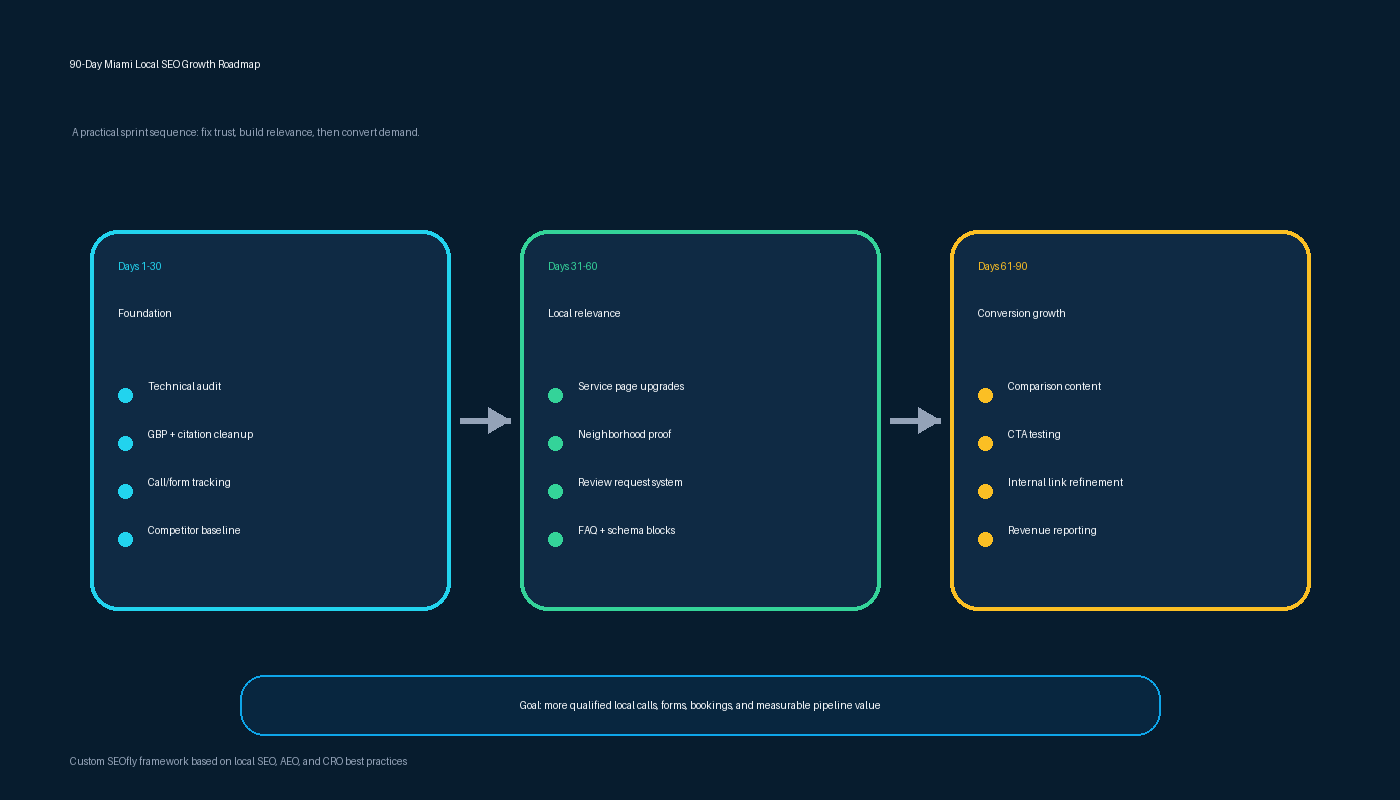
| Timeline | Primary focus | Key actions | Expected outcome |
|---|---|---|---|
| Days 1-30 | Foundation and tracking | Audit indexation, GBP, citations, analytics, call tracking, page speed, internal links, and top competitor pages | Clear baseline and removal of technical blockers |
| Days 31-60 | Local relevance and proof | Build or improve service pages, add neighborhood proof, strengthen review requests, publish FAQs, and add schema | Better relevance for commercial local searches |
| Days 61-90 | Authority and conversion | Publish supporting posts, improve CTAs, add comparison content, test forms, and refine internal links | More qualified calls, forms, and booked consultations |
The first month should be brutally practical. Identify which pages are indexed, which pages overlap, which pages receive impressions, and which pages produce leads. Confirm that the Google Business Profile categories match revenue priorities. Clean up citations where inconsistencies can confuse users or search systems.
The second month should focus on content depth and reputation. Build pages that directly answer buying questions. Add proof that is specific to the service and area. Start collecting reviews in a consistent cadence. If a business serves Spanish-speaking customers, plan bilingual assets carefully rather than relying on auto-translation.
The third month should optimize conversion and authority. Add comparison sections, objections, pricing guidance, before-and-after proof when appropriate, and stronger CTAs. Link supporting blog posts back to commercial pages. Review call recordings or CRM notes to determine whether inquiries are aligned with revenue goals.
FAQ: SEO Miami FL
What is SEO Miami FL?
SEO Miami FL is the process of improving a Miami-area business’s visibility in Google, Google Maps, AI answers, and other search experiences for local commercial searches. It usually includes technical SEO, Google Business Profile optimization, service pages, local content, reviews, citations, internal links, schema, and conversion tracking.
How long does local SEO take in Miami?
Most Miami businesses should expect meaningful local SEO movement within 90 to 180 days, depending on competition, website condition, review strength, and content depth. Faster gains may come from fixing technical issues and Google Business Profile gaps, while competitive service keywords often require sustained authority building.
Is Google Business Profile enough for Miami SEO?
Google Business Profile is essential, but it is not enough by itself. Competitive Miami businesses also need optimized service pages, review velocity, local citations, fast mobile UX, FAQs, internal links, and conversion-focused content. Maps visibility and organic visibility work best when they reinforce each other.
Should Miami businesses create neighborhood pages?
Yes, but only when the pages are useful and differentiated. A good neighborhood page explains the service, local relevance, proof, reviews, travel or service-area context, and FAQs. Thin pages that simply swap city names can create duplicate-content problems and weak user experience.
How do reviews affect Miami local SEO?
Reviews influence trust, click-through behavior, conversion rates, and local discovery. BrightLocal reports that 97% of consumers read reviews for local businesses and that consumers use an average of six review sites when choosing businesses.4 In Miami, fresh and specific reviews can help a provider stand out in crowded categories.
Why does AEO matter for local SEO in 2026?
AEO matters because customers increasingly ask answer engines and AI tools for recommendations, comparisons, and shortlists. A page that gives clear direct answers, structured FAQs, consistent entity signals, and credible proof is easier for both people and AI systems to understand and cite.
How much should a Miami business invest in SEO?
Investment should reflect competition, lead value, and growth goals. A high-value service business in legal, medical, financial, home services, or luxury real estate may justify a larger budget because one new customer can be worth thousands of dollars. The right budget should be tied to revenue targets and tracked by qualified leads.
Conclusion: Win the Miami search market before competitors do
Miami local search is becoming more competitive, more multilingual, more review-driven, and more influenced by AI recommendations. The businesses that win in 2026 will not be the ones publishing generic blog posts and hoping rankings improve. They will be the ones building a complete visibility system: technical trust, Google Business Profile strength, service-page relevance, neighborhood proof, fresh reviews, answer-first content, and conversion tracking.
If your business wants to compete in Miami, now is the time to move. SEOfly’s onboarding capacity is intentionally limited so each campaign gets strategy, implementation, and measurement attention. Claim your free SEO growth audit today and see where your Miami competitors are outranking, out-answering, and out-converting you before the next high-intent customer chooses someone else.
References
Footnotes
-
U.S. Census Bureau, “QuickFacts: Miami-Dade County, Florida” ↩ ↩2 ↩3 ↩4 ↩5 ↩6 ↩7
-
Greater Miami Convention & Visitors Bureau, “Annual Meeting 2025 Spotlights Achievements and 2026 Outlook” ↩
-
Miami-Dade County, “Miami-Dade ranked #1 in nation for small business growth” ↩
-
BrightLocal, “Local Consumer Review Survey 2026” ↩ ↩2 ↩3 ↩4 ↩5 ↩6