For decades, business owners have asked digital marketing agencies the same critical question: "If I spend $5,000 a month on SEO, what exactly will I get in return?" In the past, the answer was often a vague promise of "more traffic" and "better rankings." In 2026, that answer is no longer acceptable. With the shift toward Answer Engine Optimization (AEO) and AI-driven search, traffic volume is less important than intent validation. Businesses need a concrete seo roi calculator to forecast revenue, understand customer acquisition costs, and measure the true impact of their search visibility.
This guide breaks down exactly how to calculate your SEO return on investment in the age of AI search. We will explore the formulas used by top-tier agencies, how AEO fundamentally alters the conversion math, and what a realistic timeline looks like for high-stakes industries. Whether you are a local contractor or a national medical practice, understanding these metrics is the first step to turning search from an expense into a profit center.
Table of Contents
- How do you calculate SEO ROI?
- Why is AEO changing the ROI math in 2026?
- What is a good ROI for an SEO campaign?
- How long does it take to see a positive ROI?
- How do you measure the value of a single lead?
- What are the hidden costs of ignoring SEO?
- How can businesses improve their SEO conversion rate?
- FAQ
- Conclusion
How do you calculate SEO ROI?
Direct Answer: You calculate SEO ROI by subtracting the total cost of your SEO campaign from the total organic revenue generated by that campaign, dividing the result by the total cost of the campaign, and multiplying by 100 to get a percentage.
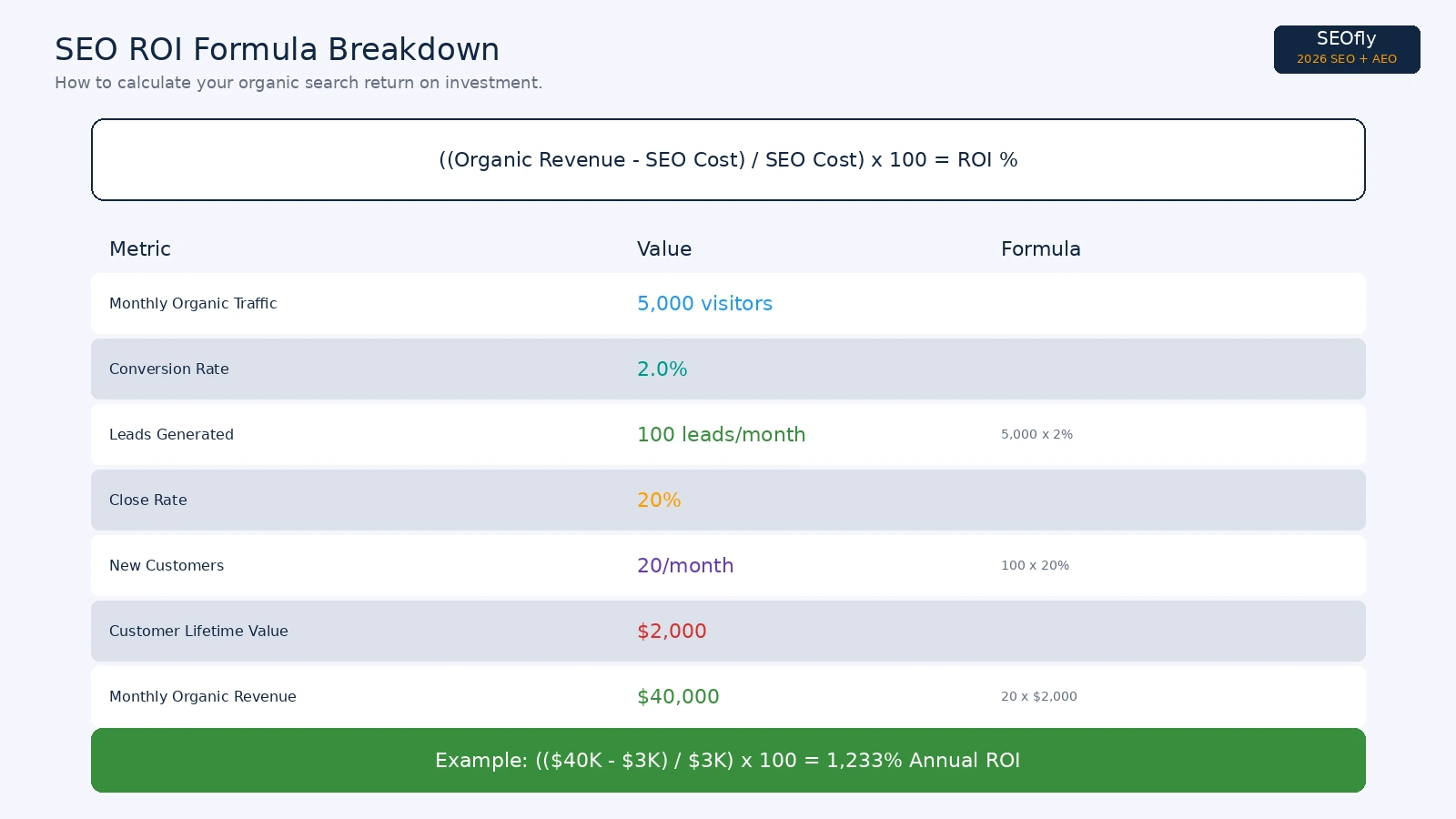
The standard formula for SEO ROI is: ((Organic Revenue - SEO Cost) / SEO Cost) * 100 = ROI %*
For example, if you spend $3,000 per month on an SEO agency ($36,000 annually), and that campaign generates $150,000 in new revenue over the year, your calculation looks like this: (($150,000 - $36,000) / $36,000) * 100 = 316% ROI.*
However, to get to that final revenue number, you must track the entire funnel. This requires multiplying your monthly organic traffic by your website's conversion rate to determine the number of leads. Then, you multiply the number of leads by your sales close rate to determine the number of new customers. Finally, you multiply the number of new customers by their Customer Lifetime Value (CLV).
If your website gets 5,000 organic visitors, converts at 2% (100 leads), closes at 20% (20 customers), and your CLV is $2,000, your organic revenue is $40,000. Understanding these micro-metrics is essential before launching a campaign, which is why we emphasize tracking in our How AI Search Is Changing SEO guide.
Why is AEO changing the ROI math in 2026?
Direct Answer: AEO is changing the ROI math in 2026 because AI overviews capture high-intent users and answer their basic questions before they click, resulting in lower overall traffic volume but a dramatically higher conversion rate for the traffic that does arrive.
In the traditional SEO model, a website might receive 10,000 visitors from a broad keyword, but because the intent was mixed, the conversion rate might be a dismal 0.5%. The ROI math relied on massive volume to generate a handful of sales.
Answer Engine Optimization (AEO) flips this dynamic. AI search engines like Google's AI Overviews and ChatGPT synthesize information and answer the user's initial questions directly on the search results page. If a user clicks through to your website from an AI citation, they have already validated their intent. They are not looking for basic information; they are looking to hire you or buy your product.
As a result, an AEO-optimized page might only receive 2,000 visitors, but because the intent is so high, it converts at 4%. You are getting fewer clicks, but generating more revenue. This shift from volume to intent is why specialized strategies, like those outlined in our Best Plastic Surgeon SEO guide, are outperforming traditional, broad-match campaigns.
Free SEO Audit: Are you measuring the right metrics? Get a free, comprehensive AEO audit from SEOfly to discover if your current strategy is focused on vanity traffic or actual revenue generation. Request your free audit today.
What is a good ROI for an SEO campaign?
Direct Answer: A good ROI for an SEO campaign is generally considered to be between 200% and 500% over a 12-month period, though high-ticket industries like law, medical, and home remodeling frequently see ROIs exceeding 1,000% once the campaign matures.
The definition of a "good" ROI is highly dependent on your profit margins and Customer Lifetime Value (CLV). An e-commerce store selling $20 t-shirts needs a massive volume of traffic to achieve a 300% ROI. Conversely, a roofing contractor selling $25,000 roof replacements might only need two organic leads to close per month to achieve a 1,500% ROI.
When evaluating an agency, do not accept generic ROI promises. A specialized agency will build a custom forecast based on your specific closing rates and average ticket size. If an agency cannot explain how their strategy will impact your specific bottom line, they are selling you rankings, not revenue.
Comparison: ROI Expectations by Industry
| Industry | Avg. Monthly SEO Spend | Avg. Customer Value | Target 12-Month ROI |
|---|---|---|---|
| Personal Injury Law | $5,000 - $15,000 | $15,000 - $100,000+ | 800% - 2,000%+ |
| Cosmetic Surgery | $4,000 - $10,000 | $8,000 - $20,000 | 500% - 1,200% |
| Home Remodeling | $2,500 - $6,000 | $15,000 - $50,000 | 600% - 1,500% |
| Local Services (HVAC) | $1,500 - $3,500 | $500 - $8,000 | 300% - 800% |
| E-commerce (Low Ticket) | $3,000 - $8,000 | $50 - $200 | 150% - 300% |
Mid-post value offer: Want to know exactly what ROI your business should expect? Contact SEOfly for a free conversion audit. We will plug your numbers into our proprietary forecasting model and show you the revenue potential of an AEO campaign.
How long does it take to see a positive ROI?
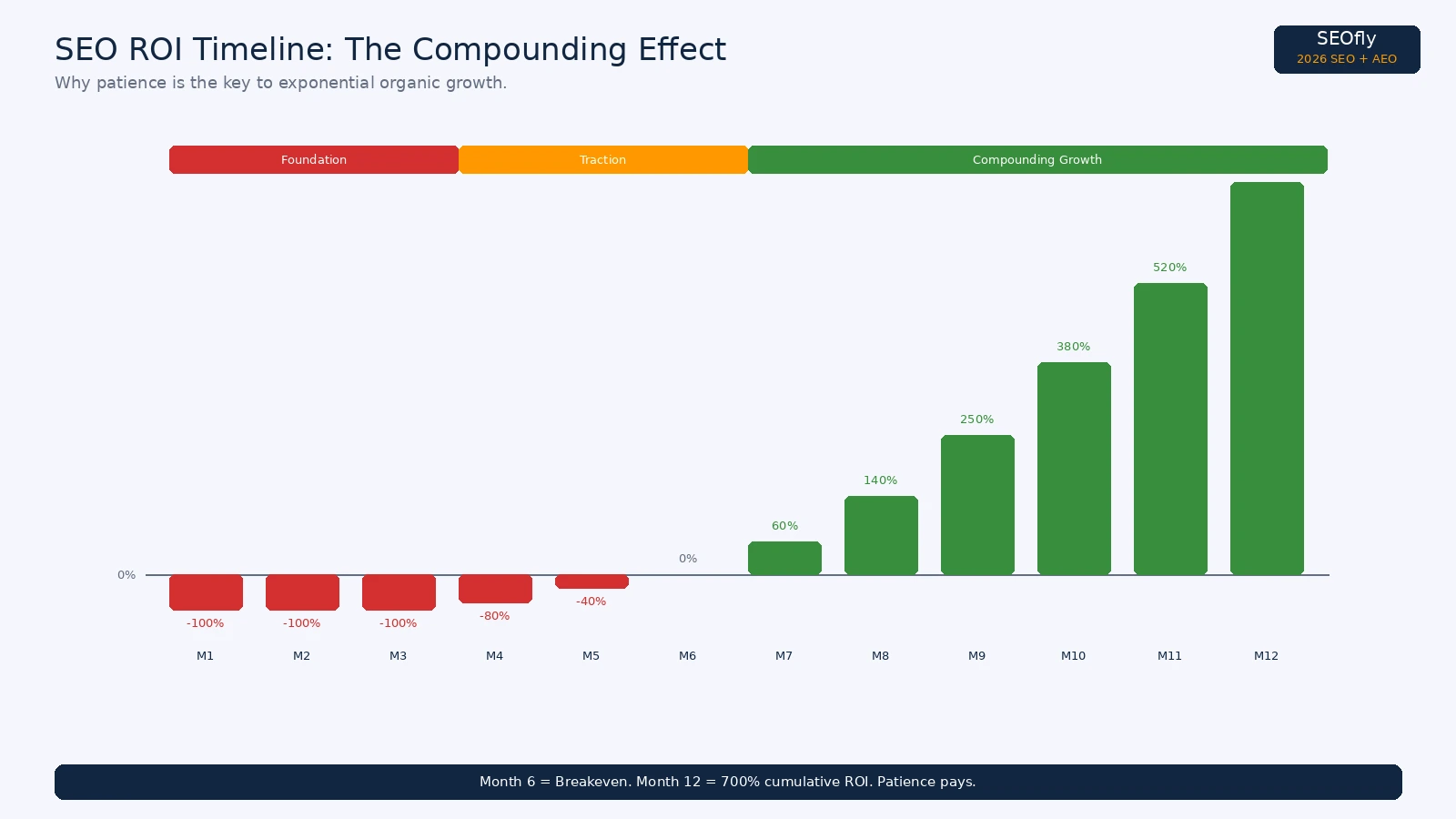
Direct Answer: It typically takes 6 to 9 months to see a positive ROI from a new SEO campaign, as the first 3 months are dedicated to technical fixes and content creation, while months 4 through 6 involve building authority and gaining traction in AI overviews.
SEO is a compounding asset, much like a retirement account. In the first few months, you are contributing capital without seeing an immediate return. The agency is restructuring your website for AEO, fixing technical errors, writing Answer-First content, and establishing your E-E-A-T (Experience, Expertise, Authoritativeness, and Trustworthiness).
By month 6, the foundation is set, and the site begins to capture long-tail, high-intent traffic. This is when the campaign usually breaks even. From month 9 onward, the ROI begins to scale exponentially. The content published in month 2 continues to generate leads in month 12, without requiring additional ad spend.
Business owners who cancel an SEO campaign in month 4 because they "aren't seeing enough leads" are abandoning the investment right before the compounding interest takes effect.
How do you measure the value of a single lead?
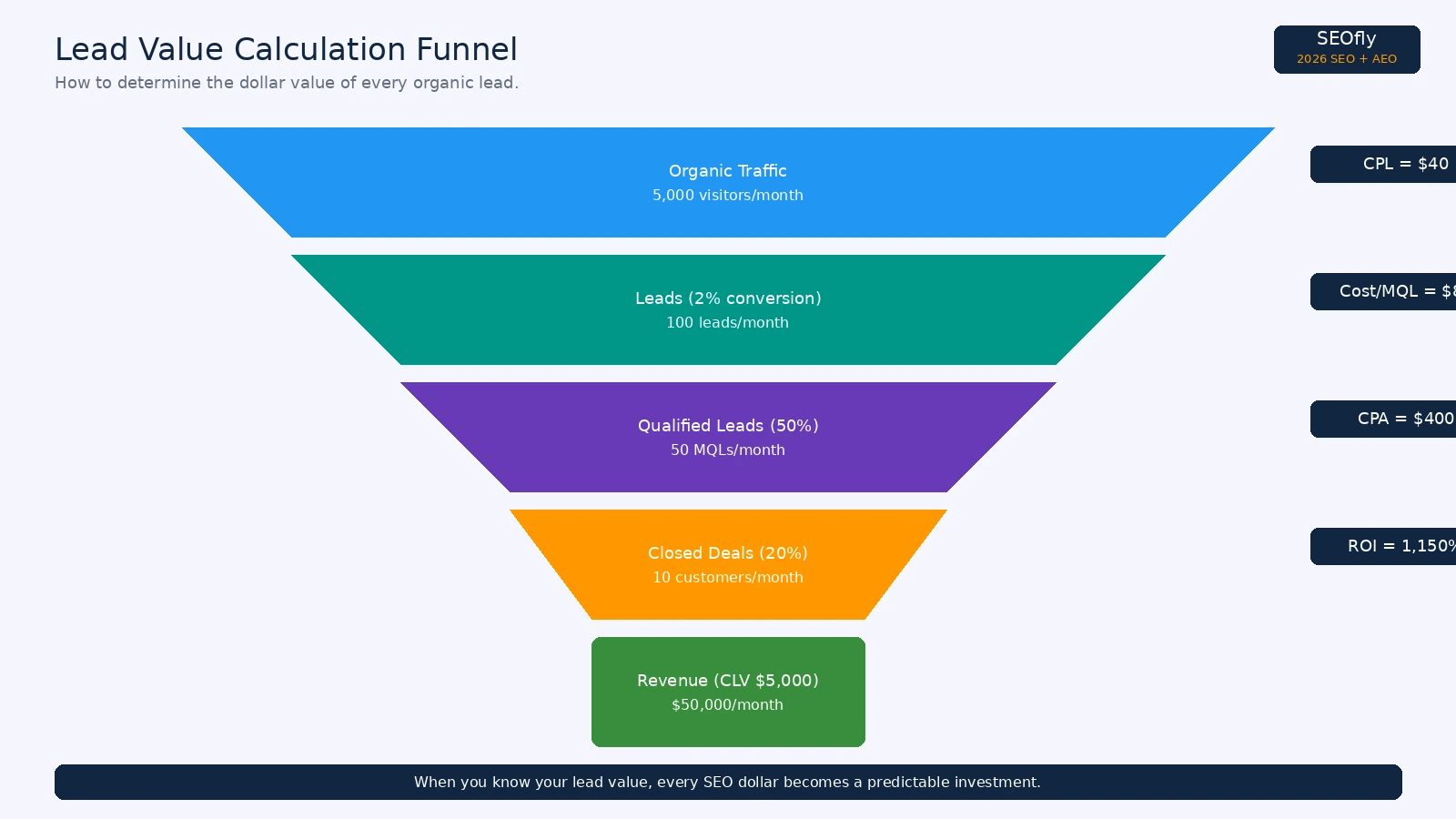
Direct Answer: You measure the value of a single lead by multiplying your average Customer Lifetime Value (CLV) by your sales team's average close rate; if your CLV is $10,000 and you close 20% of leads, every single organic lead is mathematically worth $2,000.
Understanding the value of a single lead is the secret to scaling a business aggressively. When you know that every time the phone rings it is worth $2,000 to your business, you can confidently invest $500 to make that phone ring.
Many businesses fail at SEO because they look at the cost of the agency rather than the cost of the lead. If you pay an agency $4,000 a month, and they generate 10 leads, your Cost Per Lead (CPL) is $400. If your lead value is $2,000, you are netting $1,600 in value every time they generate a lead.
This mathematical approach is exactly how we scale campaigns for high-ticket clients, as demonstrated in our HVAC SEO vs Roofing SEO case studies.
What are the hidden costs of ignoring SEO?
Direct Answer: The hidden costs of ignoring SEO include an over-reliance on increasingly expensive pay-per-click (PPC) advertising, the loss of market share to competitors who capture high-intent AI search traffic, and a severely diminished brand valuation due to a lack of digital authority.
When you ignore organic search, you are forced to rent your traffic from Google Ads or Meta. In 2026, PPC costs in competitive industries are astronomical. A personal injury lawyer might pay $250 for a single click. When you turn off the ads, the leads stop instantly.
Furthermore, consumers trust organic results and AI citations significantly more than sponsored ads. If your competitor is consistently cited by AI engines as the authoritative answer to industry questions, they are building brand equity that money cannot buy. Over time, their Customer Acquisition Cost (CAC) will drop to a fraction of yours, allowing them to underbid you on projects or outspend you on expansion.
How can businesses improve their SEO conversion rate?
Direct Answer: Businesses can improve their SEO conversion rate by aligning landing page content with the specific intent of the search query, using Answer-First formatting to build immediate trust, and placing clear, urgency-driven Calls to Action (CTAs) above the fold.
Generating traffic is only half the battle; converting that traffic is where the ROI is realized. If a user lands on your page after asking an AI engine a specific question, your page must immediately confirm that they are in the right place.
Do not use generic hero headers like "Welcome to Our Company." Instead, use a hyper-specific H1 that matches their intent, such as "Emergency Cast Iron Pipe Replacement in Miami." Follow that immediately with a direct answer to their most pressing concern (e.g., "We can have a technician on-site within 60 minutes").
Finally, reduce friction. If you want them to call, make the phone number a sticky, clickable button on mobile. If you want them to fill out a form, ask for the minimum amount of information necessary to qualify the lead. Conversion Rate Optimization (CRO) is the multiplier that turns a good SEO campaign into a great one.
FAQ
Conclusion
Understanding how to calculate your return on investment is the difference between treating digital marketing as a gamble and treating it as a predictable growth engine. The seo roi calculator math is clear: when you combine the compounding nature of organic search with the high-intent conversion rates of Answer Engine Optimization, the long-term returns dwarf almost any other marketing channel.
However, achieving these results in 2026 requires patience, precision, and a partner who understands the new rules of AI search. If you are still paying an agency for generic blog posts and monthly ranking reports that do not tie back to actual revenue, you are wasting your marketing budget.
You need a strategy built on data, structured for AI extraction, and optimized for human conversion.
SEOfly specializes in building high-ROI, AEO-driven campaigns for businesses in competitive, high-ticket industries. We don't just track traffic; we forecast revenue and optimize for signed cases and closed contracts. We only take on 5 new clients per month to ensure our team can deliver the intensive, specialized work required to dominate AI search. Don't leave your 2026 revenue to chance—contact SEOfly today to discover your true organic potential.